Saturday, October 11, 2014

Spooky and Subtle Images

0 comments

Bromoils are spooky and subtle.  They are implicitly about time.  At first glance they can resemble old photographs, like Daguerreotypes, for instance.  But on closer inspection they’re also very different.  Greater detail, particularly in the midrange emerges, so that the experience of looking at them is not so much the experience of discovering what has been lost, but seeing hidden detail emerge.  In that respect they can have an aesthetic effect like the Meisterstiche of Albrecht Durer.


A friend of ours, Elise Lajeunesse, practices the art and we went to her exhibition at the Sprague Branch of the Salt Lake City Public Library last night.  The subjects of the images in the collection are eclectic and surprising, from medieval cathedrals and castles to lost Coney Island posters to landscapes.  The room where they’re being shown is spacious and pleasant and the art is well lit which isn’t always the case.  We’ve just seen the “Witches and Wicked Bodies” exhibition at the British Museum, which includes some of Durer’s wood block prints, and this morning I find myself considering art that is dynamic through the subtle emergence of detail which can be ironic, even shocking.

In Michelangelo Antonioni’s movie “Blow-Up” the photographer discovers a murder as he sequentially blows-up images of a photograph of a man and woman in Maryon Park in London.  As the images are cropped and exploded the detail increases in contrast making it more severe and the visual revelation of the murder almost gothic.  That came to mind last night as I was looking at Elise’s elegant and mysterious image of Winchester Cathedral.

One last thing, one of the other aspects of Bromoils I find appealing is the process of creating the image itself.  It can begin digitally, but, the longest, most difficult and labor intensive portion of the process is physical and requires a highly personal and subjective manipulation of ink and paper.

Wednesday, October 8, 2014

Setting Out, a poem (for Haakon)

0 comments


I set out in the morning, 
      To ski the Wasatch beneath wind threaded skies,
      Or to go fencing, my blades and gear well packed
      Like the young man who set out to go hawking
      a thousand years ago.

But I am old and tangled in memory,
      I have skied so many times.
      Some of those who skied with me are gone,
      The one who taught me to ski with as much beauty
            as I could find
      Is gone.

So setting out is fraught with the ambivalence of memory.

Maybe it was for the young man, too,
      Who came across the battle of Maldon,
      And so that he could take up arms,
            set his beloved hawk on the wing
      To fly into the dark forest
      Knowing he should never see him again.

Setting out, I remember you
      Your green eyes, knowing, brave, always true
      And I remember that terrible night when I let you go,
      As if releasing you to fly from my wrist,
      Away into memory.

-Thomas Jensen

Sunday, October 5, 2014

Trying to Conceptualize London

3 comments

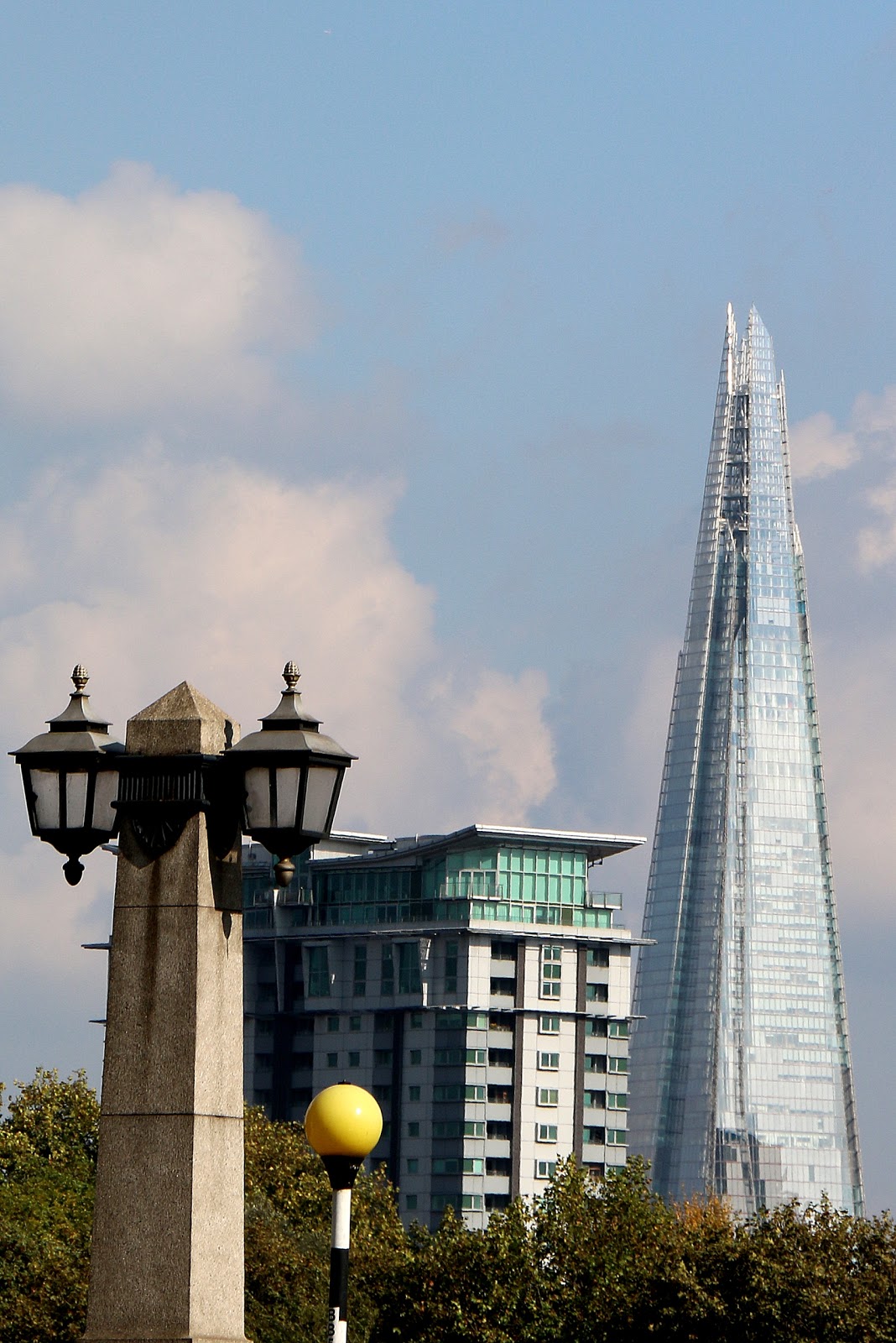
One of the cheeriest, thorny problems I’m fortunate to have to consider frequently is how to think about London.  It remains, without doubt, after innumerable visits, my favorite city.  I’m a virtual Londoner.  These days there are 8.3 million true Londoners; only the “Great Book of the Internet,” as a very perspicacious 16th century female re-enactor in Stirling Castle calls it, might be able to count the number of virtual Londoners.


Yet, in spite of all the new gem-cut glass and steel or just plain weird and whimsical skyscrapers, it remains also a small town in the very best sense.  When I think of the time we’ve just spent there that theme comes to mind.

We got up much too early a week ago last Saturday, drove from Cooper Knowe’s House at the edge of the western Isles of Scotland, where we’d been staying, avoided several red deer on the edge of the road in the darkness, through a magnificent sunrise before Loch Lomond, got a tad lost in Glasgow, and took a very reasonable Virgin train to London Euston and a fine London cab to our flat on Stamford Street in Southwark (Received Pronunciation:  “sʌðək” or “sʌvək”; an issue best left for closing time of the Spade and Becket pub in Cambridge.)  That evening we walked the few blocks to the Tate Modern where we ate at the Restaurant on the sixth floor at a table next to the window looking over the Thames and across the River to Paul’s.  A note about the Restaurant at the Tate.  It violates a major rule of world cuisine which is that inevitably the quality of the food is inversely proportional to the quality of the view.  The Restaurant at the Tate has always been good in my experience and that Saturday evening, after a long travel day, it was excellent.


Sunday morning, after toast, coffee, with Internet news and a more substantial munch of a cheddar and pickle sandwich at the Pret two doors down we were off to the intimate British Museum.  Some days it seems like 4.15 million of the true Londoners plus again as many tourists are there.  Sunday was no exception.  Yet, as soon as I engage with something, usually an old friend like an artifact from Sutton Hoo, all the other visitors recede into a vague, Whovian alternate dimension.  And I always discover something new.  This time there were several including a bronze head of the Assyrian King of the Wind Demons “Pazuzu” (remember the scariest moment in "The Exorcist:” when Max Von Sydow as a priest/archaeologist stares down the stone effigy of the demon in a dusty Iraq archaelogical site with a snarling dog between?), a truly spooky exhibition of illustrations of witches throughout time and last, but not least, a classic Greek vase with the best illustration of Theseus and the Minotaur I’ve ever seen.


It was difficult to believe the dry, pleasant almost summery weather after Scotland.  And evening brought a much anticipated first visit to the Sam Wanamaker Playhouse.  The new theatre, a recreation of Inigo Jones’ Blackfriar’s Theatre used by Shakespeare, seats 340 and is lit only by candlelight.  We had the great pleasure of hearing a concert of Indian music celebrating Rabindranath Tagore by Soumik Datta, Souvid Datta, Rosabella Gregory, Fiona Bevan and Anoushka Shankar.  I don’t know Indian music so I had to listen very carefully and work hard which was wonderful to do in such a small, comfortable space.  I’ve been trying to come up with an accurate meaningful superlative and can’t.  I’ll have to make due with a simile instead.  Imagine hearing jazz for the first time from Dave Brubeck live in a perfect, small space with extraordinary acoustics.  It was something like that. 

Monday we decamped for a day trip by fast train to Canterbury.  I know it’s not London; but with the fast train, it’s virtually London, and, walking through the town to the Cathedral I sensed that the town is struggling a little with identity and economy for that reason.  The top of my list was a kind of personal pilgrimage to the tomb of the Black Prince which felt necessary and appropriate since I’d recently published my novel, As a Black Prince on Bloody Fields.  The cathedral was unusually empty.  Still, I managed to hear several interesting revisions of the Black Prince’s history from tour guides.  One of the most interesting was that the Black Prince was buried in Canterbury Cathedral because his wife, Joan the Fair Maid of Kent, was buried in the crypt below the cathedral.  Romantic but wrong:  she outlived him and is buried in Lincolnshire next to her first husband.  I also spoke to a charming woman member of staff who conveyed the usual ambivalence about his tomb’s presence in the cathedral particularly because of the sack of Limoges and a general discomfort with Canterbury’s dual role as both a place of worship and a national monument.  By the way, the Black Prince’s history at Limoges may not be nearly as dark as Froissart impugned based on a new letter of the Prince’s that was recently found http://www.bbc.com/news/magazine-28161434.  On the way out we stopped to share a quick beer at the Bishop’s Finger Pub (also according to their sign the oldest brewer in England) which Robert pronounced as excellent.


Back in London in the early evening we saw “Dr. Scroggy’s War,” Howard Benton’s new play, at the Globe which dramatizes the exploits of Dr. Harold Gillies, the physician who pioneered plastic surgery for treatment of the horrific facial wounds during World War I.  It’s a comedy.  No really.  Well, to be accurate “historical-comical,” to use Polonius's phrase.  It’s a good play, Benton wrote it for the Globe and makes effective use of Shakespearean techniques.  It explores the issues of human identity and purpose with a kind of quiet rhetorical structure whilst remaining perfectly accessible.  Afterwards, we went next door to the Swan for an after play drink amidst some of the actors whom Lynn had the audacity and good sense to congratulate on their performances.  I know it’s shallow to say so but, wow, they’re a good looking group.


Our last full day we spent at Churchill’s War Rooms and at an exhibit of late Turner the Tate Britain.  And that brings me back to where I started about scale.  “…in that small time” Shakespeare writes of Henry V.  The same could be said of the underground warren from which Churchill and his staff led the last defense of Europe until the US entered World War II.  The place is full of the music of history, to use John Meacham’s brilliant phrase in his description of Churchill.  Then there was the Turner exhibit of late works.  It is so large, reflects such great creativity that I couldn’t wrap my mind around it even with a full afternoon.  It would require weeks.  They should warn you.  And we couldn't leave the Tate Britain without looking at the Pre-Raphaelites as always.


We finished with dinner at Tamarind in Mayfair, which is still spectacular and innovative after 20 years.

Back at the flat, Robert played the traveling guitar he’d purchased in Perth and which he’d been playing evenings and mornings the entire trip.  He played some compositions of his own as well as some Baroque pieces he’s been working on.  It’s so easy to grow accustomed to live music.  And my cousin is getting to be really good.


Friday, September 26, 2014

Mythology, Loch Ailort, Scotland, kelpies

0 comments


A windy, changeable morning.  Sunlit rays of mist slant across the brooding glens of pyramidical Rois Bheinn.  We've been here at Cooper's Knowe House for most of a week.  A frisky black black horse with a mottled gray companion, frolics, grazes and occasionally, on a whim, rears and neighs in the early mornings.  I don't know his name.  But he's a broad, strong horse and is the perfect image of a kelpie, the Scottish mythological demon that lives deep in the lochs, emerges from the deep in the shape of a black horse to lure human victims to ride on their backs whence they are taken back into the depths and devoured.

On the way here, we stopped in several small towns.  In one not far from Gleneagles where the Ryder Cup Golf tournament is underway we found an immense "wickerman" golfer statue.  It was early morning and the village seemed deserted which gave the cheery, wry monument an ominous cast.  I imagined a cheerful old Scot inviting us to stay a day or two to be the "honoured" guests at their celebration.


Since gale force winds are forecast we're off to Fort William today to see the west Highland museum there which is supposed to have some fine artifacts from the rebellion of '45.  I sense Charles Edward Stuart's reputation is rising again, in spite of the 1700 highlanders that died under his leadership at Culloden on that wet stormy day in April 1746.

Outside of Falkirk are two great steel sculptures of the horseheads of kelpies symbolizing both the mythic past and industrial strength of Scotland.  The night before last, we had dinner in Inverness at Cafe 1.  It was best dinner we've had yet and one of the best I've ever had in the UK.  Between courses I decided to ask the young lady serving us how she'd voted in the referendum.  She was happy to tell us and to say why.  Her explanation was insightful, well-reasoned and demonstrated what one might call formidably clear, critical thinking which is exactly the kind of strength Scotland needs, of course.


Tuesday, September 23, 2014

In the Western Isles - Roshven, Scotland

0 comments

The BBC is reporting today that the Scottish National Party, the SNP, has added 17,000 members since it lost the referendum vote on independence a few days ago.  I infer that a lot of people have discovered or rediscovered a national identity.

And I've been re-reading Robert Louis Stevenson's "Kidnapped" since we've been traveling in the Scottish highlands.  The design of the drama of the narrative is so elegant and compelling it's easy to miss that Stevenson's novel functions on several levels, sometimes simultaneously.  For example, the subject of the conversations between David Balfour and Alan Breck Stuart are, often as not, concerned with their dramatic predicament and their strategy for avoiding capture by the government forces or Clan Campbell.  The same conversations also serve to explicate the values, social structure and mores of the highland culture of the time.  Indeed the dramatic or rhetorical turn of those dialogues rest more often on the latter than the former.  It is as a travel novel that I find "Kidnapped" most engaging this time through.  Of course it's time travel,too, and an excellent entree into the 4-dimensionality of the place through which we're moving physically.

One of the central, unspoken issues at the heart of the novel is national identity.  Scotland was diverse and complicated in the 1100s, the 1200s, the 1700s and now.  Whether or not its future leads to independence from the UK or not, it has just done something very remarkable.  It has considered and made a decision about the independence of the country peacefully.  To these grim eyes it seems rather heroic.

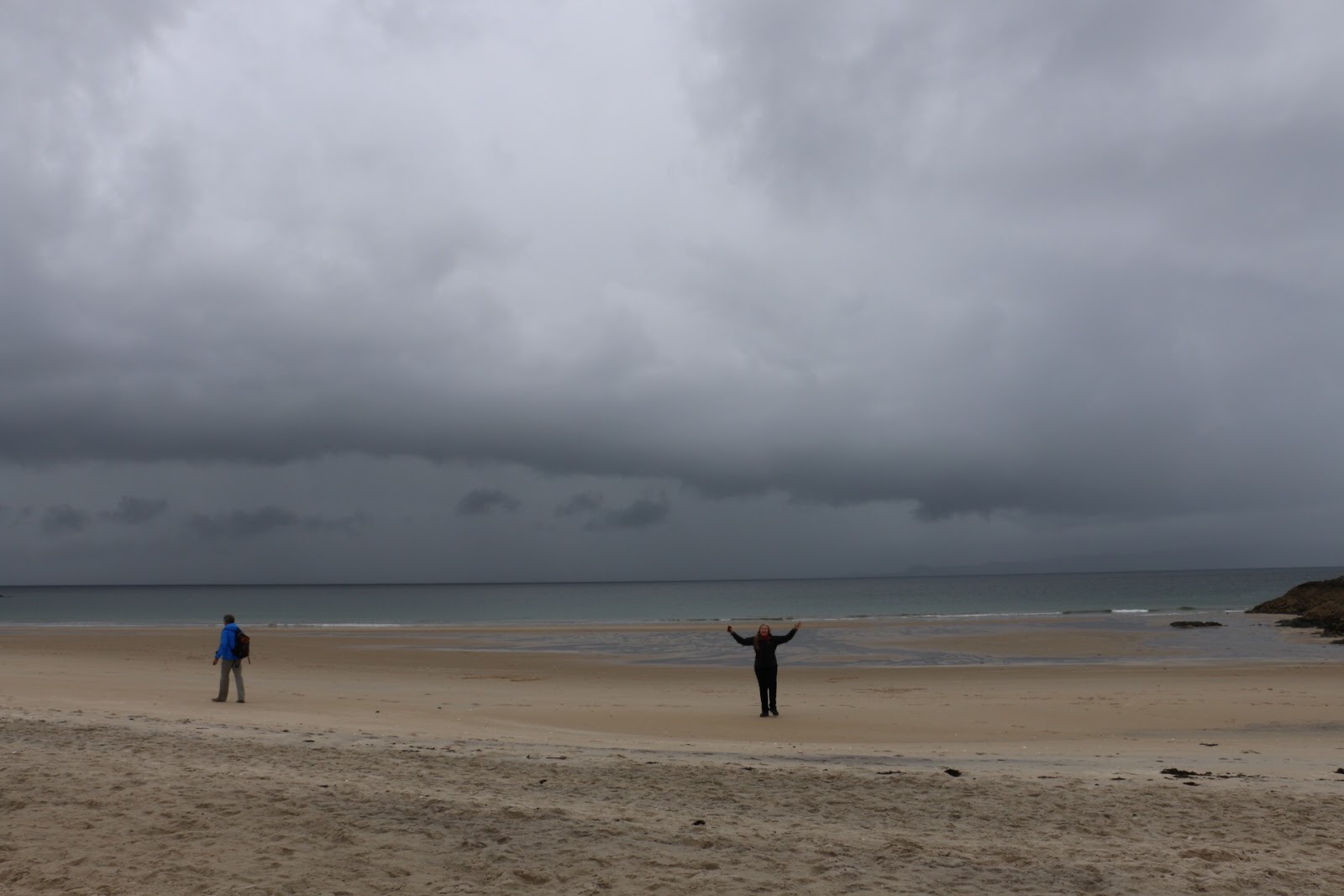
Yesterday, we spent a fine day walking around and photographing Tioram Castle.  Today we walked the desolate beach where "Local Hero" was filmed.


Friday, September 19, 2014

0 comments

Auchterarder, Perthshire, Scotland.  In a small, cottage at the back of Stirling Castle in Sterling, a twenty million pound project to recreate the complete set of the Unicorn Tapestries that once adorned the royal palaces in the castle is underway.  Those that are finished and already hanging capture the brilliance of the originals when they were first created.  Nothing, even imagination, prepares you for the immediacy of them.

Yesterday, Lynn, Robert and I went hawking.  A long afternoon walking rugged fields and some woods with two Goshawks and two master falconers yielded just two rabbits and a partridge.  But I learned and experienced more of the natural world and its order than I have in years.  Since, one important early chapter of my novel is concerned with medieval falconry based on literary sources and much less personal experience years ago, I must admit to not a little trepidation about how I'd feel about the book after.  The good news was that my imagination did good service.  There's very little I would change now.

That said,  I don't know that anyone has ever captured the immediacy and suspense of that experience.


Imagination is always a work in progress.

Friday, September 12, 2014

The Unnamed Knight

0 comments

Mark Twain blamed Chivalry for the American Civil War.  He thought that southern gentlemanly values had its roots in Sir Walter Scott,

“But for the Sir Walter disease, the character of the Southerner-- or Southron, according to Sir Walter`s starchier way of phrasing it-- would be wholly modern, in place of modern and medieval mixed, and the South would be fully a generation further advanced than it is. It was Sir Walter that made every gentleman in the South a Major or a Colonel, or a General or a Judge, before the war; and it was he, also, that made these gentlemen value these bogus decorations. For it was he that created rank and caste down there, and also reverence for rank and caste, and pride and pleasure in them. Enough is laid on slavery, without fathering upon it these creations and contributions of Sir Walter.”

Really?  Were Ivanhoe, the Waverly novels and Sir Walter Scott’s fictive conception of Chivalry responsible the socio-economic structure of the south and the religious institutions that rationalized and supported it?

In any case, there can be no doubt that there’s a strong current of anti-chivalric sentiment in English and American letters from the mid-nineteen century onwards.  The lost generation found the sentiment particularly appealing.  The irony, of course, is that American letters, even Twain and later Hemmingway, Fitzgerald, Faulkner and Mamet never eschewed chivalry they just portrayed it (unnamed but rightly) as something that can exist independent of class, caste, ethnicity or sex.  (That’s also not new, Thomas Malory portrayed Sir Palomides as an African after all.)  And even Huck Finn as well as Bayard Sartoris were guilty of behavior that can only be called chivalrous.

I bring this up in the context of the horrific murders of the two journalists, James Foley and Steven Sotloff, at the hands of the of the self-proclaimed “Islamic State.”  The black ninja-dressed executioner was of British origin and apparently there are numerous benighted Americans among their ranks as well.  We wonder why.  Perhaps, partly, it is a grotesquely corrupted but natural urge to serve a greater good in the absence of any humane “chivalric” values that could serve to direct that will to power to more virtuous ends.

Picasso loved knights, the symbolism, the ironies, the allusions.


"Be without fear in the face of your enemies. Be brave and upright that God may love thee. Speak the truth always, even if it leads to your death. Safeguard the helpless and do no wrong. That is your oath.  Rise a knight."  - William Monahan ("Kingdom of Heaven")