One of the
cheeriest, thorny problems I’m fortunate to have to consider frequently is how
to think about London. It remains,
without doubt, after innumerable visits, my favorite city. I’m a virtual Londoner. These days there are 8.3 million true
Londoners; only the “Great Book of the Internet,” as a very perspicacious 16th
century female re-enactor in Stirling Castle calls it, might be able to count
the number of virtual Londoners.
Yet, in
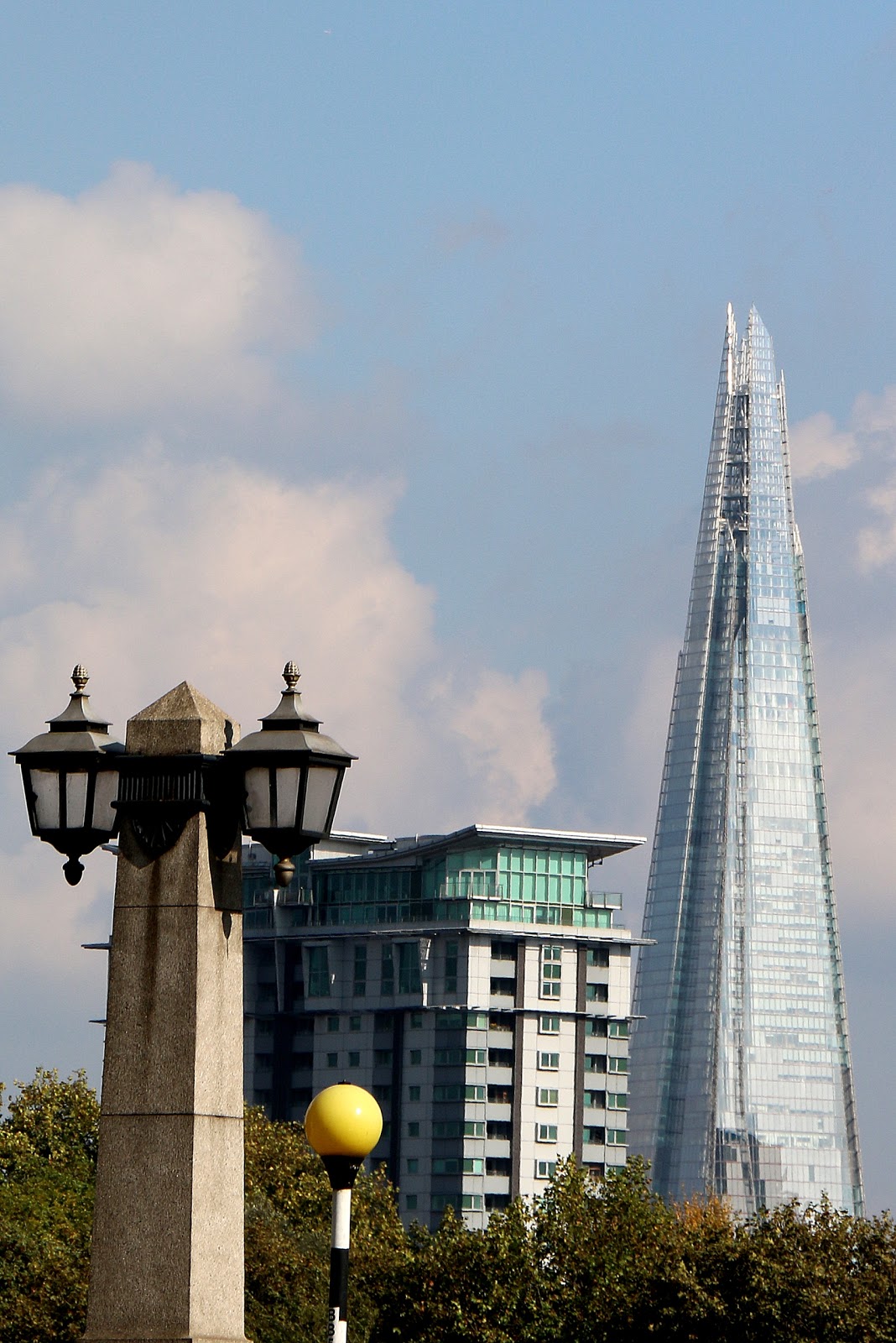
spite of all the new gem-cut glass and steel or just plain weird and whimsical
skyscrapers, it remains also a small town in the very best sense. When I think of the time we’ve just spent there
that theme comes to mind.
We got up
much too early a week ago last Saturday, drove from Cooper Knowe’s House at the
edge of the western Isles of Scotland, where we’d been staying, avoided several
red deer on the edge of the road in the darkness, through a magnificent sunrise
before Loch Lomond, got a tad lost in Glasgow, and took a very reasonable
Virgin train to London Euston and a fine London cab to our flat on Stamford
Street in Southwark (Received Pronunciation:
“sʌðək” or “sʌvək”; an issue best left for closing time of the Spade and
Becket pub in Cambridge.) That evening
we walked the few blocks to the Tate Modern where we ate at the Restaurant on
the sixth floor at a table next to the window looking over the Thames and
across the River to Paul’s. A note about
the Restaurant at the Tate. It violates a
major rule of world cuisine which is that inevitably the quality of the food is
inversely proportional to the quality of the view. The Restaurant at the Tate has always been
good in my experience and that Saturday evening, after a long travel day, it
was excellent.

Sunday
morning, after toast, coffee, with Internet news and a more substantial munch of
a cheddar and pickle sandwich at the Pret two doors down we were off to the intimate
British Museum. Some days it seems like
4.15 million of the true Londoners plus again as many tourists are there. Sunday was no exception. Yet, as soon as I engage with something,
usually an old friend like an artifact from Sutton Hoo, all the other visitors
recede into a vague, Whovian alternate dimension. And I always discover something new. This time there were several including a
bronze head of the Assyrian King of the Wind Demons “Pazuzu” (remember the
scariest moment in "The Exorcist:” when Max Von Sydow as a priest/archaeologist
stares down the stone effigy of the demon in a dusty Iraq archaelogical site with a snarling dog
between?), a truly spooky exhibition of illustrations of witches throughout
time and last, but not least, a classic Greek vase with the best illustration
of Theseus and the Minotaur I’ve ever seen.


It was
difficult to believe the dry, pleasant almost summery weather after Scotland. And evening brought a much anticipated first
visit to the Sam Wanamaker Playhouse.
The new theatre, a recreation of Inigo Jones’ Blackfriar’s Theatre used
by Shakespeare, seats 340 and is lit only by candlelight. We had the great pleasure of hearing a
concert of Indian music celebrating Rabindranath Tagore by Soumik Datta, Souvid
Datta, Rosabella Gregory, Fiona Bevan and Anoushka Shankar. I don’t know Indian music so I had to listen
very carefully and work hard which was wonderful to do in such a small, comfortable
space. I’ve been trying to come up with
an accurate meaningful superlative and can’t.
I’ll have to make due with a simile instead. Imagine hearing jazz for the first time from
Dave Brubeck live in a perfect, small space with extraordinary acoustics. It was something like that.
Monday we
decamped for a day trip by fast train to Canterbury. I know it’s not London; but with the fast
train, it’s virtually London, and, walking through the town to the Cathedral I
sensed that the town is struggling a little with identity and economy for that
reason. The top of my list was a kind of
personal pilgrimage to the tomb of the Black Prince which felt necessary and
appropriate since I’d recently published my novel, As a Black Prince on Bloody Fields. The cathedral was unusually empty. Still, I managed to hear several interesting
revisions of the Black Prince’s history from tour guides. One of the most interesting was that the
Black Prince was buried in Canterbury Cathedral because his wife, Joan the Fair
Maid of Kent, was buried in the crypt below the cathedral. Romantic but wrong: she outlived him and is buried in Lincolnshire
next to her first husband. I also spoke
to a charming woman member of staff who conveyed the usual ambivalence about
his tomb’s presence in the cathedral particularly because of the sack of Limoges
and a general discomfort with Canterbury’s dual role as both a place of worship
and a national monument. By the way, the
Black Prince’s history at Limoges may not be nearly as dark as Froissart impugned
based on a new letter of the Prince’s that was recently found http://www.bbc.com/news/magazine-28161434. On the way out we
stopped to share a quick beer at the Bishop’s Finger Pub (also according to
their sign the oldest brewer in England) which Robert pronounced as excellent.


Back in London
in the early evening we saw “Dr. Scroggy’s War,” Howard Benton’s new play, at
the Globe which dramatizes the exploits of Dr. Harold Gillies, the physician
who pioneered plastic surgery for treatment of the horrific facial wounds during
World War I. It’s a comedy. No really.
Well, to be accurate “historical-comical,” to use Polonius's phrase. It’s a good play, Benton wrote it for the
Globe and makes effective use of Shakespearean techniques. It explores the issues of human identity and purpose with a kind of quiet rhetorical structure whilst remaining perfectly accessible. Afterwards, we went next
door to the Swan for an after play drink amidst some of the actors whom Lynn
had the audacity and good sense to congratulate on their performances. I know it’s shallow to say so but, wow, they’re
a good looking group.

Our last
full day we spent at Churchill’s War Rooms and at an exhibit of late Turner the
Tate Britain. And that brings me back to
where I started about scale. “…in that
small time” Shakespeare writes of Henry V.
The same could be said of the underground warren from which Churchill
and his staff led the last defense of Europe until the US entered World War
II. The place is full of the music of
history, to use John Meacham’s brilliant phrase in his description of
Churchill. Then there was the Turner
exhibit of late works. It is so large,
reflects such great creativity that I couldn’t wrap my mind around it even with
a full afternoon. It would require
weeks. They should warn you. And we couldn't leave the Tate Britain without looking at the Pre-Raphaelites as always.
We finished
with dinner at Tamarind in Mayfair, which is still spectacular and innovative
after 20 years.
Back at the
flat, Robert played the traveling guitar he’d purchased in Perth and which he’d
been playing evenings and mornings the entire trip. He played some compositions of his own as
well as some Baroque pieces he’s been working on. It’s so easy to grow accustomed to live
music. And my cousin is getting to be
really good.