Showing posts with label Scotland. Show all posts

Sunday, November 2, 2014

Morning with a Rock Star

0 comments

You know how it is:  you meet a rock star and you want to tell everyone about it.


Earlier this autumn in Scotland, we went hawking, to use the preferred 14th century term, with two goshawks.  Birds of prey are never domesticated.  They can be trained but, to my mind, it is really more of a negotiation, culminating in a contract of expectations between two dissimilar and wary participants.  Here’s a clause from the contract:  if I, the party of the second part, the human, raise my gauntlet to form a perch, the party of the first part, the hawk, can expect there is something raw and scrumptious on the gauntlet which will merit the flight of the party of the first part to that perch on the wrist of the party of the second part.  The penalty for violating the contract can be high.  With some birds, such as the striated Caracara from the Falklands, the contracts can also be very intricate.  They are intelligent and murderous lawyers.


Here is a way to fall in love:  watch a Goshawk skimming low across an autumnal field in pursuit of her prey, the tapestry of her great rounded wings slightly undulating to make her flight perfectly smooth and precise.  In my case it was a particularly beautiful, appropriately vain and slightly capricious Goshawk named Freya.  As I learned in one of my first lessons in powered flight years ago, flying close to the ground is by far the most exhilarating and dangerous kind.  And yes, I am quite aware that this was a case of unrequited love.


But Freya wasn’t the rock star.  The rock star was a hybrid, one half Falco Peregrinus, that is, a Peregrine Falcon, with whom we spent some time earlier that day.  Even though I had a very fast shuttered camera, every photo I have of the falcon is blurred.  She was simply too fast.  Falcons hunt high and stoop to kill other birds in flight.  That morning, as soon as the falcon took wing, the wintry sky filled with other birds seeking to fly above the soaring falcon to where they would be safe.

We had several conversations about the natural history of various birds of prey with Adrian, the master falconer leading our little expedition.  For example, the plumage of a juvenile Peregrine Falcon differs  dramatically from that of the adult.  When fledglings leave the nest, they’re barely competent flyers, poor hunters and sexually immature.  The plumage serves to inform any adult falcons, whose territory the juveniles may be crossing, that they are neither threat nor competition and can be allowed to pass unmolested.  Their juvenile plumage thus gives them the best chance of completing their essential journey and surviving until they find a place in the world which they can make their own.

Which leads me to my reason for hawking.  There are few other experiences that bring you into such immediate and empathetic proximity to the wild and natural world.  Yet, even in the most urban environments the wilderness is still with us and within us.


Friday, September 26, 2014

Mythology, Loch Ailort, Scotland, kelpies

0 comments


A windy, changeable morning.  Sunlit rays of mist slant across the brooding glens of pyramidical Rois Bheinn.  We've been here at Cooper's Knowe House for most of a week.  A frisky black black horse with a mottled gray companion, frolics, grazes and occasionally, on a whim, rears and neighs in the early mornings.  I don't know his name.  But he's a broad, strong horse and is the perfect image of a kelpie, the Scottish mythological demon that lives deep in the lochs, emerges from the deep in the shape of a black horse to lure human victims to ride on their backs whence they are taken back into the depths and devoured.

On the way here, we stopped in several small towns.  In one not far from Gleneagles where the Ryder Cup Golf tournament is underway we found an immense "wickerman" golfer statue.  It was early morning and the village seemed deserted which gave the cheery, wry monument an ominous cast.  I imagined a cheerful old Scot inviting us to stay a day or two to be the "honoured" guests at their celebration.


Since gale force winds are forecast we're off to Fort William today to see the west Highland museum there which is supposed to have some fine artifacts from the rebellion of '45.  I sense Charles Edward Stuart's reputation is rising again, in spite of the 1700 highlanders that died under his leadership at Culloden on that wet stormy day in April 1746.

Outside of Falkirk are two great steel sculptures of the horseheads of kelpies symbolizing both the mythic past and industrial strength of Scotland.  The night before last, we had dinner in Inverness at Cafe 1.  It was best dinner we've had yet and one of the best I've ever had in the UK.  Between courses I decided to ask the young lady serving us how she'd voted in the referendum.  She was happy to tell us and to say why.  Her explanation was insightful, well-reasoned and demonstrated what one might call formidably clear, critical thinking which is exactly the kind of strength Scotland needs, of course.


Tuesday, September 23, 2014

In the Western Isles - Roshven, Scotland

0 comments

The BBC is reporting today that the Scottish National Party, the SNP, has added 17,000 members since it lost the referendum vote on independence a few days ago.  I infer that a lot of people have discovered or rediscovered a national identity.

And I've been re-reading Robert Louis Stevenson's "Kidnapped" since we've been traveling in the Scottish highlands.  The design of the drama of the narrative is so elegant and compelling it's easy to miss that Stevenson's novel functions on several levels, sometimes simultaneously.  For example, the subject of the conversations between David Balfour and Alan Breck Stuart are, often as not, concerned with their dramatic predicament and their strategy for avoiding capture by the government forces or Clan Campbell.  The same conversations also serve to explicate the values, social structure and mores of the highland culture of the time.  Indeed the dramatic or rhetorical turn of those dialogues rest more often on the latter than the former.  It is as a travel novel that I find "Kidnapped" most engaging this time through.  Of course it's time travel,too, and an excellent entree into the 4-dimensionality of the place through which we're moving physically.

One of the central, unspoken issues at the heart of the novel is national identity.  Scotland was diverse and complicated in the 1100s, the 1200s, the 1700s and now.  Whether or not its future leads to independence from the UK or not, it has just done something very remarkable.  It has considered and made a decision about the independence of the country peacefully.  To these grim eyes it seems rather heroic.

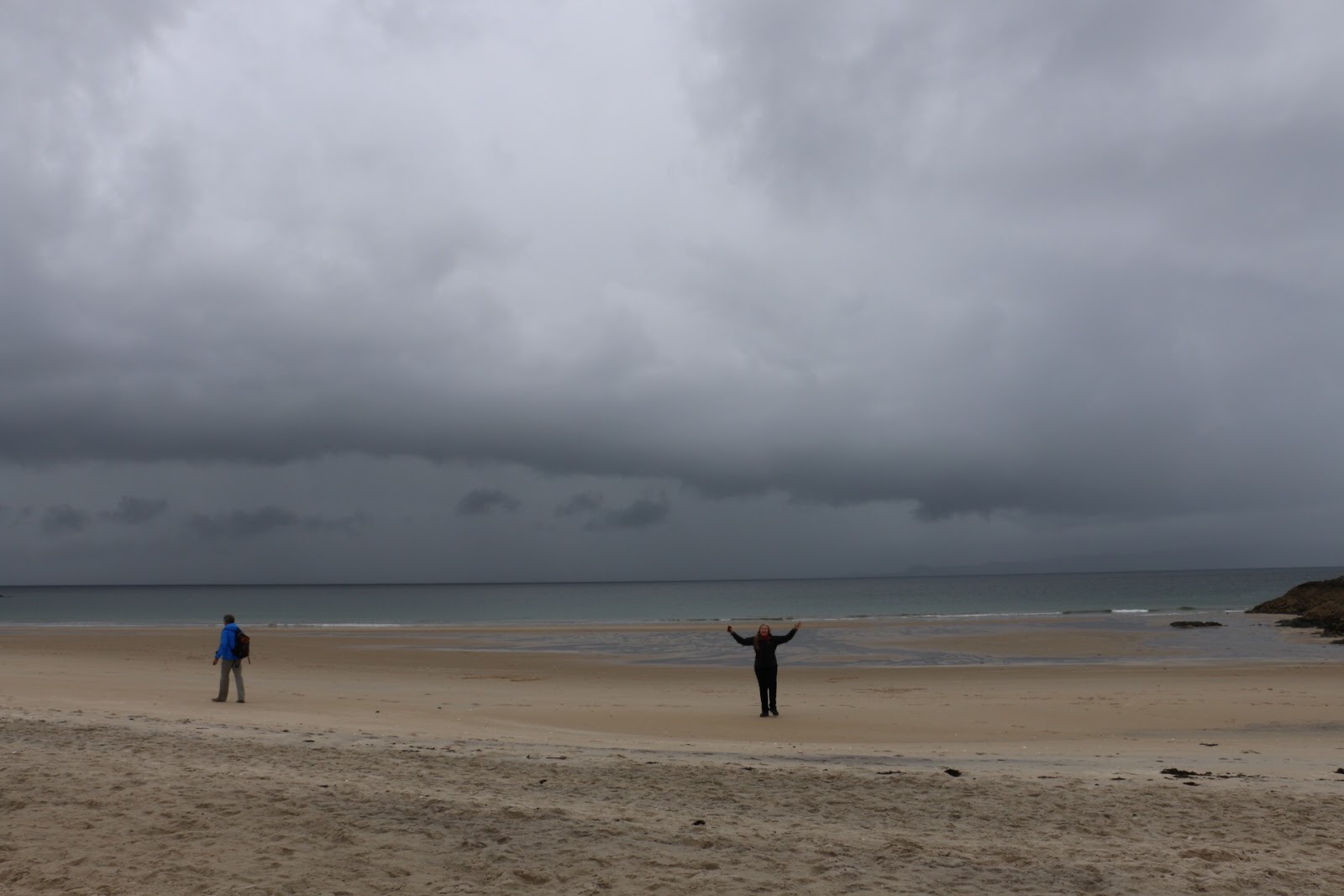
Yesterday, we spent a fine day walking around and photographing Tioram Castle.  Today we walked the desolate beach where "Local Hero" was filmed.


Friday, September 19, 2014

0 comments

Auchterarder, Perthshire, Scotland.  In a small, cottage at the back of Stirling Castle in Sterling, a twenty million pound project to recreate the complete set of the Unicorn Tapestries that once adorned the royal palaces in the castle is underway.  Those that are finished and already hanging capture the brilliance of the originals when they were first created.  Nothing, even imagination, prepares you for the immediacy of them.

Yesterday, Lynn, Robert and I went hawking.  A long afternoon walking rugged fields and some woods with two Goshawks and two master falconers yielded just two rabbits and a partridge.  But I learned and experienced more of the natural world and its order than I have in years.  Since, one important early chapter of my novel is concerned with medieval falconry based on literary sources and much less personal experience years ago, I must admit to not a little trepidation about how I'd feel about the book after.  The good news was that my imagination did good service.  There's very little I would change now.

That said,  I don't know that anyone has ever captured the immediacy and suspense of that experience.


Imagination is always a work in progress.