Tuesday, September 23, 2014
In the Western Isles - Roshven, Scotland
The BBC is reporting today that the Scottish National Party, the SNP, has added 17,000 members since it lost the referendum vote on independence a few days ago. I infer that a lot of people have discovered or rediscovered a national identity.
And I've been re-reading Robert Louis Stevenson's "Kidnapped" since we've been traveling in the Scottish highlands. The design of the drama of the narrative is so elegant and compelling it's easy to miss that Stevenson's novel functions on several levels, sometimes simultaneously. For example, the subject of the conversations between David Balfour and Alan Breck Stuart are, often as not, concerned with their dramatic predicament and their strategy for avoiding capture by the government forces or Clan Campbell. The same conversations also serve to explicate the values, social structure and mores of the highland culture of the time. Indeed the dramatic or rhetorical turn of those dialogues rest more often on the latter than the former. It is as a travel novel that I find "Kidnapped" most engaging this time through. Of course it's time travel,too, and an excellent entree into the 4-dimensionality of the place through which we're moving physically.
One of the central, unspoken issues at the heart of the novel is national identity. Scotland was diverse and complicated in the 1100s, the 1200s, the 1700s and now. Whether or not its future leads to independence from the UK or not, it has just done something very remarkable. It has considered and made a decision about the independence of the country peacefully. To these grim eyes it seems rather heroic.
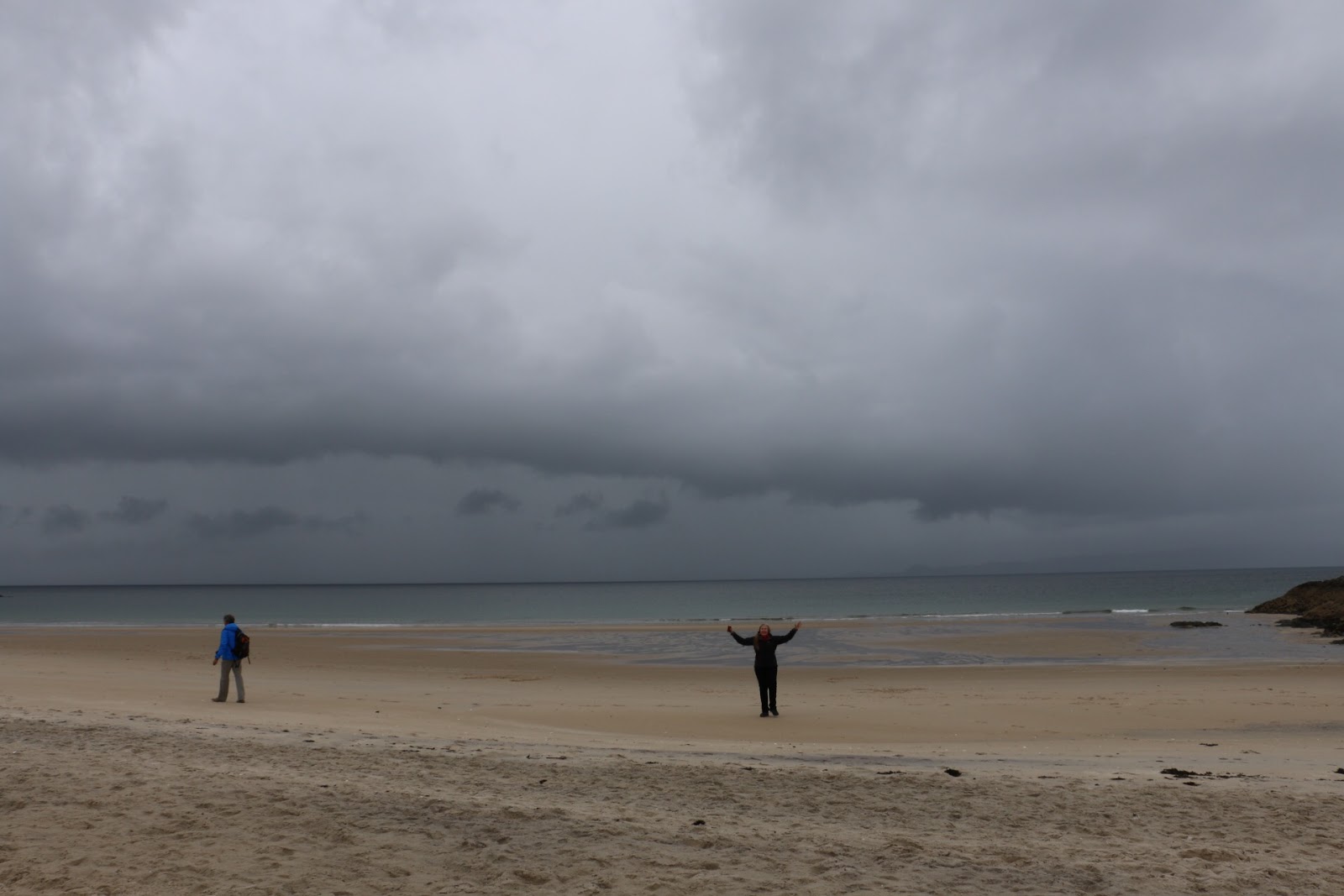
Yesterday, we spent a fine day walking around and photographing Tioram Castle. Today we walked the desolate beach where "Local Hero" was filmed.
Labels:
Fiction,
Kidnapped,
Robert Louis Stevenson,
Scotland,
Scottish National Party,
SNP
Friday, September 19, 2014
Auchterarder, Perthshire, Scotland. In a small, cottage at the back of Stirling Castle in Sterling, a twenty million pound project to recreate the complete set of the Unicorn Tapestries that once adorned the royal palaces in the castle is underway. Those that are finished and already hanging capture the brilliance of the originals when they were first created. Nothing, even imagination, prepares you for the immediacy of them.
Yesterday, Lynn, Robert and I went hawking. A long afternoon walking rugged fields and some woods with two Goshawks and two master falconers yielded just two rabbits and a partridge. But I learned and experienced more of the natural world and its order than I have in years. Since, one important early chapter of my novel is concerned with medieval falconry based on literary sources and much less personal experience years ago, I must admit to not a little trepidation about how I'd feel about the book after. The good news was that my imagination did good service. There's very little I would change now.
That said, I don't know that anyone has ever captured the immediacy and suspense of that experience.
Imagination is always a work in progress.
Friday, September 12, 2014
The Unnamed Knight
Mark Twain blamed Chivalry for the American Civil War. He thought that southern gentlemanly values
had its roots in Sir Walter Scott,
“But for the Sir Walter disease, the character of the
Southerner-- or Southron, according to Sir Walter`s starchier way of phrasing
it-- would be wholly modern, in place of modern and medieval mixed, and the
South would be fully a generation further advanced than it is. It was Sir
Walter that made every gentleman in the South a Major or a Colonel, or a
General or a Judge, before the war; and it was he, also, that made these
gentlemen value these bogus decorations. For it was he that created rank and
caste down there, and also reverence for rank and caste, and pride and pleasure
in them. Enough is laid on slavery, without fathering upon it these creations
and contributions of Sir Walter.”
Really? Were Ivanhoe, the Waverly novels and Sir Walter Scott’s fictive conception of Chivalry responsible the socio-economic structure of the south and the religious institutions that rationalized and supported it?
In any case, there can be no doubt that there’s a strong
current of anti-chivalric sentiment in English and American letters from the
mid-nineteen century onwards. The lost
generation found the sentiment particularly appealing. The irony, of course, is that American
letters, even Twain and later Hemmingway, Fitzgerald, Faulkner and Mamet never
eschewed chivalry they just portrayed it (unnamed but rightly) as something that
can exist independent of class, caste, ethnicity or sex. (That’s also not new, Thomas Malory portrayed
Sir Palomides as an African after all.) And
even Huck Finn as well as Bayard Sartoris were guilty of behavior that can only
be called chivalrous.
I bring this up in the context of the horrific murders of
the two journalists, James Foley and Steven Sotloff, at the hands of the of the self-proclaimed “Islamic State.” The black ninja-dressed executioner was of
British origin and apparently there are numerous benighted Americans among
their ranks as well. We wonder why. Perhaps, partly, it is a grotesquely corrupted
but natural urge to serve a greater good in the absence of any humane “chivalric”
values that could serve to direct that will to power to more virtuous ends.
Picasso loved knights, the symbolism, the ironies, the
allusions.
"Be without fear in the face of your enemies. Be brave and upright that God may love thee. Speak the truth always, even if it leads to your death. Safeguard the helpless and do no wrong. That is your oath. Rise a knight." - William Monahan ("Kingdom of Heaven")
Labels:
James Foley,
Kingdom of Heaven,
knight,
Steven Sotloff,
terrorism,
William Monahan
Sunday, September 7, 2014
As a Black Prince on Bloody Fields
One of my novels, “As a Black Prince on
Bloody Fields,” is seeing the light of day.
I’ll let the words on the back cover speak for it.
"An uncertain sixteen year-old in black
armor steels himself to lead the vanguard of his father’s army on a muddy
battlefield. It is a stormy day in
August, 1346. He is Edward Plantagenet,
called “the Black Prince.” The place is
“The Valley of the Clerks,” near the town of Crecy, France.
This is the story of his youth and
adulthood as he tells it, from a childhood among lions in the Tower of London
to his love for a woman whose life is as wild and exceptional as his own. She is Joan, called “the Fair Maid of Kent,”
renowned for her beauty.
At 26, after years of vast social and
economic change and the desolation of the Black Death, Edward returns to France
in another desperate gambit to save his father’s kingdom and discover who he
truly is. Before Henry V and Agincourt
there was Edward and Crecy and Poitiers.
And Joan.”
If you’re reading this, hopefully you’re
wondering whether you would be interested in reading the novel. Maybe you’re wondering why I wrote it.
When I was fourteen and first starting to
write a lot I wanted to write the kind of books I liked to read. They were the books of adolescence, the books
you live inside, the books for which you grieve when they end, sometimes to the
point of tears. And I devoured them. I remember reading The Lord of the Rings over
two rainy summer days mostly outside.
The snow-tipped mountains visible from our backyard never looked so
green.
Later, in graduate school, I wondered if
that was sentimentality.
Now, much later, I perceive that response
as proportional and proper for anyone at that time and place in life. The books were creating whom I aspired to be,
who I was and who I am now. They merit
tears. I never would have been able to
love and live in War and Peace that
first time through if it hadn’t been for reading J. R. R. Tolkien four years
before.
What were the books? I’ve already mentioned Tolkien, (who 41 years
after his death amazed me with his translation of Beowulf beautifully
assembled by his son Christopher.) There
was T. H. White who may been one of the first since Chaucer and Thomas Mallory
to portray the medieval world as intimate, which it was. There was Mary Renault, whose novels of
ancient Greece, particularly the Theseus and Alexander novels, imagined and
portrayed sexuality and gender with the breadth and nuance that had escaped
even the more literal members of the lost generation. Then there was Dumas, Hemingway, Faulkner
and, surprisingly late at 18, Shakespeare, the greatest love of my literary
life.
Quite simply I’ve tried to write a book I
would have wanted to read then and would read now.
I have no illusions about belonging in
that great company mentioned above but their influence is evident and might be
a clue as to whether you’d want read my book.
It concerns the Hundred Years War, the
same hundred years of devastation that inspired George R. R. Martin’s “Fire and
Ice” fantasy books and the HBO “Game of Thrones” series. That period of European history has its vast
share of dramatic and fictional treatments, from Shakespeare to Bernard
Cornwell. But, to my knowledge there are
few, if any, that attempt to imagine the personal experience of the Black Prince, which
must have been amazing.
That's why I wrote it. If you're interested in a review, you can find one on the Kirkus Reviews website: https://www.kirkusreviews.com/book-reviews/thomas-w-jensen/as-a-black-prince-on-bloody-fields/
The wicked cool cover was designed by Carolina Fiandri, CirceCorp Design. You can purchase the paperback and the Kindle eBook directly from Amazon now.
Wednesday, August 15, 2012
Fencing Idea
My two favorite sports in the Olympics that just finished were fencing and archery. I fence and have for several years. What I know about archery I learned from Errol Flynn’s “Robin Hood:” I’ve never pulled a bow in my life. These Olympics were by far the best in memory simply because of the diversity of sports available to watch. It was also interesting to learn that watching the events as they were streamed was much more immediate and compelling than the occasional truncated and theatrically commentated versions that showed up on one of the television stations later.
The simple reason was that the streamed versions usually had less comment provided by more focused and knowledgeable commentators. I found the streamed events more dramatic, more involving and they made me want to watch more.
The disparity in coverage set me to wondering what would make fencing more interesting to a general audience, a topic of obvious interest to the sport’s national and international governing bodies, the USFA and the FIE. Here’s a thought. Perhaps fencing needs some events liberated from the conventional strip. Modern sport fencing evolved from dueling. But swords were used in many other contexts and situations. Epee is the most obvious candidate for such an extension because it isn’t encumbered with the complexity of right of way.
Still, developing such a sport , whatever it would be, would be far from trivial. Nevertheless, it’s worth some formal experimentation. And it will need a fanatical champion whatever it is. But, there’s precedent: consider the relatively new diversity of biking and skiing events.
Friday, February 3, 2012
1895
When I was in graduate school I developed a method for solving particularly difficult mathematical problems of the kind that sometimes took days. The strategy was to keep the problem “lightly” in mind all the time. By lightly I mean, focusing continually on the problem and the pertinent details and related deductions while avoiding obsessing about any particular strategy for solving it. The longer I’d go, the more difficult it would become to preserve the state of willed obsession and yet the solution would finally come, often emerging spontaneously, proving that sometimes the deepest reasoning the mind does is subconscious.
January felt like that. I’ve been thinking about how to restructure my fencing training and competition in order to become a better fencer. As part of another project I’ve been reading some archaeological research, in particular Stein et al’s “Revisiting Downtown Chaco” and George Pepper’s 1905 paper “Ceremonial Objects and Ornaments from Pueblo Bonito.” As an adolescent I imagined that science and knowledge developed linearly. Later, I learned that even in something as rigorous as mathematics, the development of knowledge is much more like the development of a theme in musical composition. Important knowledge is reasoned, or discovered, then lost and rediscovered sometimes simultaneously. In the light of Lekson’s revolutionary history of the ancient southwest it might be a good time to review Pepper’s work chronicling the finds of the Hyde/Putnam excavations. If Lynn were reading this over my shoulder she’d no doubt bring up “The Glass Bead Game,” and rightly, too.
In January I also had a bout with the flu as has she. The flu sucks. In “Seven Pillars of Wisdom,” T.E. Lawrence describes how he developed his famous strategy for the Arab insurgency while suffering a severe illness. Unfortunately, I have to report that my own recent illness led to no such astonishing insights, at least that I’d recognize as such.
There was a compensation, however. We’ve just seen the BBC production “Sherlock Series 2,” the second installment of the modern day re-imagining of Sherlock Holmes by Steven Moffat and Mark Gatiss. The first series of three feature length films was a perfect delight. And yet, the second series surpasses it. It was by far the best drama I’ve seen in the last year and notably puts to shame every American film we’ve seen since “Michael Clayton.” They are literate, witty and filled with original dramatic riffs built from modern technological culture.
They are also allusive. Dr. Watson’s blog happens to latch at 1895, which was also was the original Holmes’ annus mirabulis, the year of some of his greatest mysteries. I’m inclined to think that 2011, was Moffat and Gatiss’s 1895.
Friday, December 16, 2011
Christopher Hitchens (1949-2011)
So Christopher Hitchens is gone. He died in harness having just published feisty rebuttal to Nietzche aphorism that whatever doesn’t kill me makes me stronger. Like a lot of people, I often found I disagreed with him, particularly during the early years of the Bush administration. But I consistently admired his will to reason and particularly the way in which he bravely followed the consequences of his reasoning. He was a journalist with a philosopher’s aspiration to truth and honesty which is rare these days, even among philosophers.
Vanity Fair and the Guardian each have a fine memoriam and Vanity Fair has a nice collection of his rejoinders on video.
Labels:
Christopher Hitchens,
Philosophy
Subscribe to:
Posts (Atom)