Sunday, November 21, 2010
What I'm Reading, What I've Just Seen: "The Fears of Henry IV," "Agora"
My deep interest in history comes, I believe, as a result of wanting to understand how we came to be what we are. My particular fondness for the late medieval (13th and 14th centuries) stems from the general parallels between that age and our own. It was a time of significant cultural, scientific and industrial change. Institutions were either failing or reinventing themselves. The consequence was the Renaissance, obviously.
The last few years have yielded especially fine books on the subject. Juliet Barker’s Agincourt and Ian Mortimer’s 1415: Henry V’s Year if Glory are by far the most compelling and engaging books I’ve read on the subject. Barker’s empathetic rendering of Henry and Mortimer’s much more critical one, pull you inside life at that time better than anything else I’ve read, history or fiction. Barker’s book is worth it for the description of the battle of Shrewsbury and the subsequent treatment of then Prince Henry’s facial wound alone, but is much, much more. Mortimer provides a day by day narrative of Henry’s life and major events in Europe for all of 1415 and, as a result, gave me an utterly new perspective on that age. If you want to understand that time, I doubt you could do better.
And, while we were in England, I came across Mortimer’s biography of Henry IV, The Fears of Henry IV: the Life of England’s Self-Made King. It’s a much more traditional narrative, but is engaging and reveals a life much richer and deeper than one might imagine from Shakespeare or Holinshed, my first touch stones for his character. And now, Lynn has just given me Korda’s new biography of T.E. Lawrence which looks like particularly good fun. I have that peculiar sense of fantastical wealth that comes from having good books to read.
I’m also very fond of historical film although I’m a difficult audience. Example: I’m deeply fond of Ridley Scott’s “The Kingdom of Heaven” but can hardly bear his “Robin Hood.” I expect something truly exceptional about once a decade.
So it was with great joy that I recently found “Agora,” Alejandro Amenabar’s film about the life of the great female philosopher and mathematician Hypatia who lived in Alexandria in the fourth and early fifth century A.D. It’s the most ambitious film I’ve seen in recent memory; it’s portrayal of time and place are exceptional and beautifully detailed. And, Rachel Weisz’s nuanced characterization of a beautiful woman who’s great passion was understanding planetary motion while surrounded by acolytes all suffering from various kinds of unrequited love, is beautiful.
It belongs in the company of truly great historical films, such as Lean's "Lawrence of Arabia" or Ridley Scott's "The Duelists."

Monday, November 15, 2010
WSU Tournament 11-13-201 - Errol Flynn's Grin

It came to mind several times on Saturday and Sunday, thinking about the Epee Circuit Fencing Tournament at Weber State. First of all, the venue was the nicest I’ve competed in so far. However, I’d felt punk during the week and felt less than perfectly prepared. Nevertheless, in retrospect, I did about as well as I would have in any case, and though my results were very disappointing there was much about the tournament that I deeply enjoyed.
In my open senior pool bouts I lost all but one. I definitely should have won another, but changed my game at the end for no good reason. It’s an issue my coach has reminded me of on numerous occasions. However, of the other losses, there were two bouts that I came within a point of winning: both were against much better fencers, (one a C rated fencer who took second). The other was against the coach of a local club. At one stage, Kenny, my coach came by, appraised my stance and said “relax!.” That was a significant part of my problem and I did better afterwards.
My first DE was against a clubmate (which I always feel conflicted about) but I won. The second was against the C rated fencer I’d done so well against in the pools. He took me out with ease and it was slight consolation that he eventually finished second.
Lynn also didn’t do as well as she’d done in the previous tournament, but like me she faced some interesting competitors. She told me later that she’d found her DE against a woman, an affable recently retired coach to be particularly fun.
Some of my best DEs of the day were in Veterans. One, against fencer whom I haven’t faced since January, was particularly rousing. I have height and reach on my side, whilst he has experience. I took an early lead, but then he came back, sometimes attacking into my preparation, sometimes after luring me into an attack which failed. I battled back, carefully watching distance and opportunity. At 9 all, we took off our masks, saluted each other and the director. I won the final point but it could have gone either way. I lost my final DE, 7-10, also against a clubmate, but was pleased in that I’d fenced much more assertively against him, in most of the points I’d set the timing of the "conversation of blades."


Thursday, November 11, 2010
Pocatello Epee Circuit Tournament
The first Saturday, October 16 and all too soon after our return from Wales, was the USI Epee Circuit #2 tournament. Needless to say, we’d had three weeks to forget everything and I felt I’d done a particularly good job of it. In my still relatively new experience, I find that my skill as a fencer is highly dependent on the quality and amount of recent practice, my attitude and my level of adrenalin. Balancing them is as important as skill.
Nevertheless, we rose at 5:00, fed the tigers, made cheddar and Branston pickle sandwiches and coffee for breakfast on the road and set out. Though I’m a native westerner I’d never been to Pocatello and was pleased to discover how beautiful that part of Idaho was. I found autumnal distances, mountains and hills nicely settling. Lynn was particularly quiet. It was her first tournament. I completely understood.
I was very pleased with the venue, the Pocatello Methodist church, when we arrived. The gymnasium had abundant natural light from open windows through which fall trees were visible. We warmed up, dressed and greeted the people we knew and appraised the ones we didn’t.

My pool for the first event, mixed seniors, was a challenge: three C rated fencers and one other E, a clubmate, Kim Grundvig, who regularly beats me. This time, I beat her and came close with one of the Cs, the score was 5-4. Not a brilliant performance but given my lack of practice, respectable. Nevertheless, as a result, I expected immediate and certain death in my first DE. As it turned out, I won my first DE, (against another clubmate, a D rated fencer). My next DE, against another clubmate, Dakota Nollner, was another experience all together. I hadn’t fenced Dakota since early in the summer and in my estimation his fencing has taken a significant step. He was moving much better, hiding his attacks much more effectively. I won a couple of points then I never came close again.
Meanwhile, Lynn and Robert, who had been in other pools, were having some interesting times of their own. Robert told me later he found the first part of the day particularly difficult and Lynn was in the middle of a nail-biting first ever DE in which both fencers had periods of being ahead. At the end, they were tied at fourteen all and I recalled that Lynn has noted multiple times how hard it is for her at that stage in a bout to rise to the occasion. At that point, the fencers removed their masks, saluted each other and the director because it had been such a good bout and resumed. Of course, the tension was palpable. Lynn told me later that she simply decided she would not lose this time. She didn’t and won her first DE and a medal, as third among the women in the event.

In the afternoon, Lynn, Robert and I participated in a much smaller veterans event: only two additional fencers participated, one of whom, Jennifer Nopens, happens to be Dakota Nollner’s mother and the wife of our coach, Kenny Nopens. She and Kenny jointly manage our club and do a phenomenal job of it. I was aware that Robert hadn’t been doing as well as he’d liked and decided I had a good chance of medaling and perhaps even winning. And I was further encouraged by winning all four of my pool bouts. Then, in my second DE, I faced my nemesis: my cousin Robert. His fencing suddenly and dramatically improved: his stance was better, his attacks were more clever and hard to predict and though it was close at the beginning, it wasn’t at the end. His final DE, against Jenny, was a nail-biter, but Robert was as solid as I’ve ever seen him and he won the bout to take the gold. His grin in the photo says it all.


After that we watched and cheered for Kim in a particularly difficult DE with a Pocatello Club fencer, Amy McGary, in the mixed college practice event.
After the requisite ceremony and pictures, we joined Kenny and Jenny and several other members of the club for garlicky salads at Buddy’s restaurant. Kenny was chuffed: it had been a good day for our club: we’d taken first in 5 of the 7 events, and in Senior mixed, Dakota had taken third out of a field of 18.
Now, it’s November, some of the fall color is still with us but there’s snow in the peaks of the Wasatch and Oquirr mountains. Skiing is coming. We have another tournament this weekend. Time to practice.
Nevertheless, we rose at 5:00, fed the tigers, made cheddar and Branston pickle sandwiches and coffee for breakfast on the road and set out. Though I’m a native westerner I’d never been to Pocatello and was pleased to discover how beautiful that part of Idaho was. I found autumnal distances, mountains and hills nicely settling. Lynn was particularly quiet. It was her first tournament. I completely understood.
I was very pleased with the venue, the Pocatello Methodist church, when we arrived. The gymnasium had abundant natural light from open windows through which fall trees were visible. We warmed up, dressed and greeted the people we knew and appraised the ones we didn’t.

My pool for the first event, mixed seniors, was a challenge: three C rated fencers and one other E, a clubmate, Kim Grundvig, who regularly beats me. This time, I beat her and came close with one of the Cs, the score was 5-4. Not a brilliant performance but given my lack of practice, respectable. Nevertheless, as a result, I expected immediate and certain death in my first DE. As it turned out, I won my first DE, (against another clubmate, a D rated fencer). My next DE, against another clubmate, Dakota Nollner, was another experience all together. I hadn’t fenced Dakota since early in the summer and in my estimation his fencing has taken a significant step. He was moving much better, hiding his attacks much more effectively. I won a couple of points then I never came close again.
Meanwhile, Lynn and Robert, who had been in other pools, were having some interesting times of their own. Robert told me later he found the first part of the day particularly difficult and Lynn was in the middle of a nail-biting first ever DE in which both fencers had periods of being ahead. At the end, they were tied at fourteen all and I recalled that Lynn has noted multiple times how hard it is for her at that stage in a bout to rise to the occasion. At that point, the fencers removed their masks, saluted each other and the director because it had been such a good bout and resumed. Of course, the tension was palpable. Lynn told me later that she simply decided she would not lose this time. She didn’t and won her first DE and a medal, as third among the women in the event.

In the afternoon, Lynn, Robert and I participated in a much smaller veterans event: only two additional fencers participated, one of whom, Jennifer Nopens, happens to be Dakota Nollner’s mother and the wife of our coach, Kenny Nopens. She and Kenny jointly manage our club and do a phenomenal job of it. I was aware that Robert hadn’t been doing as well as he’d liked and decided I had a good chance of medaling and perhaps even winning. And I was further encouraged by winning all four of my pool bouts. Then, in my second DE, I faced my nemesis: my cousin Robert. His fencing suddenly and dramatically improved: his stance was better, his attacks were more clever and hard to predict and though it was close at the beginning, it wasn’t at the end. His final DE, against Jenny, was a nail-biter, but Robert was as solid as I’ve ever seen him and he won the bout to take the gold. His grin in the photo says it all.


After that we watched and cheered for Kim in a particularly difficult DE with a Pocatello Club fencer, Amy McGary, in the mixed college practice event.
After the requisite ceremony and pictures, we joined Kenny and Jenny and several other members of the club for garlicky salads at Buddy’s restaurant. Kenny was chuffed: it had been a good day for our club: we’d taken first in 5 of the 7 events, and in Senior mixed, Dakota had taken third out of a field of 18.
Now, it’s November, some of the fall color is still with us but there’s snow in the peaks of the Wasatch and Oquirr mountains. Skiing is coming. We have another tournament this weekend. Time to practice.
Monday, November 8, 2010
Witches, Saag Gosht, Hal and Falstaff, Air Fencing, Castles, Welsh Cliff Walks (conclusion)
Wales. Just driving on the highway I sense it as we leave Shrewsbury: the wildness of the woods, the rugged glens of the marches, the dappled sunlight. The tall arches of a ruined castle on a high green hill made me want to pull off and hike and damn the schedule.
Often the trees arch over the two lane road keeping it in shadow. Even at the edge, the allusiveness of the place is tangible; so much comes to mind at once: the Mabinogion, gentle folk, Merlin, the cruel, proud lives of the coal and slate miners, all those who came from Wales and changed the world: Elizabeth I, Inigo Jones, T. E. Lawrence, Dylan Thomas, Richard Burton, Bertrand Russell…
Especially when the October wind
(Some let me make you of Autumnal spells,
The spider-tongued, and the loud hill of Wales)…
We listened to a silly 1950’s science fiction radio drama on the BBC and drove on, all the way to the northern corner on the Irish sea: Conwy.

We were greeted by heavy rain, which is to say a light squall by Welsh standards. It took me three loops through the compact medieval walled town to find our B&B, the Gwynfryn, and approach it from the proper direction. But once again, Lynn’s careful research turned up trumps: our rather red room was spacious and comfortable and Colin, one of the two proprietors, helped us lug in our stuff and find a parking place (no small thing in a walled medieval town.) Robert’s room was, well, pink. Dinner was at the Bistro Bach which specializes is new Welsh cuisine (i.e. fresh, local ingredients, bright flavors in a warm, casual setting.) Robert and I went vegetarian while Lynn opted for the lamb.
The next morning the clouds had lifted and after Welsh Rarebit for breakfast, we were off to the castle. I’ve explored castles all over Europe, from Carcassonne to the Rhine Valley to Scotland but the castles in Wales have my heart. The meaning and history of what survives, a tracing on a mantle, or a vaulted window are highlighted by the absences of what’s gone and the misty forests and fields beyond. They provoke and transport my imagination the way no others do. And among that select company, Conwy is one of the best. Though it’s in Wales, it’s an English castle (built by the great Savoyard architect James of St. George for Edward I) and it’s a mixture of grandeur and hominess that feels quintessentially English. (All of which takes nothing away from the grandeur of the native Welsh castles such as Dolwydellan.) It’s just that as a result of history Wales is home to best of the English castles as well.

The town of Conwy also possesses one of the best, extant Tudor homes, Plas Mawr, which was where we spent the afternoon as the rain had returned. Plas Mawr is fully restored and if you give it the time and focus, it also can reveal a lot about the texture of daily Tudor life. Elizabethan England was an age of reinvention, among the political consequences was the Commonwealth; among the cultural consequences was the Age of Reason. Yet, even in that transformative time at Plas Mawr in the distant north of Wales, you see ritual and ceremony embedded in the architecture. The rain settled in and we had a respectable dinner at the Italian restaurant a couple of doors down from our B&B.


The next morning was bright and cheery and after a few snaps of the castle we headed south for Aber Falls, a favorite walk. It’s only a couple of miles long with a mild elevation yet in that time you walk through close thorps of beech, alder, hazel and sycamore trees. I took a photo of Lynn beneath a great witching, branching oak just as I had fifteen years ago and was very pleased that all three of us were hale and in the world. At the top Robert and I scrambled up a shale steep, then we photographed the falls and I found myself musing that the ancient woods of medieval Europe were wilder, more diverse and grander than anything we imagine. As we were coming back down Robert posed, a head atop a standing stone. After scrumptious cheese and pickle sandwiches at the café and community center at the base we drove to Anglesey to take a gander at a few of the pre-historic barrows and standing stones, then it was back to Conwy for dinner.

The following day was bittersweet because it meant leaving Conwy and we began our very gradual way home. After a several hours at Harlech, Y.A.T.F.C. (Yet Another of Thomas’s Favorite Castles), we arrived in Newport and our hotel Cnappan. When Lynn and I first stayed there in 1991 we almost didn’t: we drove into the small seaside town on the west coast and saw a bright pink building in the middle of all the gray ones and it was our hotel. It was foreboding, but like the stalwart heroes in a gothic novel we braved the ominous lodgings. And we were very glad we had. During those three days I had some of the best food I’ve had in my life. Two dishes, in particular, remain mythic: “the Pasty Pennebont,” a pasty of early summer vegetables and greens picked from the proprietors’ own garden the same afternoon and absolutely world’s best bread and butter pudding. The Coopers and Lloyds are still the proprietors and the food was every bit as good as I’d remembered although it was the wrong time of year for a Pasty Pennebont alas.
And for the next two days we walked. On Saturday we hiked up to the iron age forts in the hills above the coast, where, on one of the more dramatic promontories, Robert and I invented the rare art of “air fencing.” It was to become a theme for the remainder of our holiday. It’s a highly practical sport as it requires no gear and both competitors are free to imagine victory. It also offered a fine prospect of Newport and Dinas head which inspired me to recite some Dylan Thomas.
By the sea’s side, hearing the noise of birds,
Hearing the raven cough in winter sticks,
My busy heart who shudders as she talks,
Sheds the syllabic blood and drains her words…
Lynn assured me that the reason she’d married me was my ability to recite Dylan Thomas impromptu on a Welsh hillside. On the way down we passed a small cottage named Fern Hill.

She was coming down with a miserable cold that both of us ended up sharing but it didn’t keep her from the next day’s twelve mile rugged tromp around Dinas Head. The path rose and fell multiple times from sea level to several hundred feet above it and there was a substantial sea breeze. Each prospect, over a gate, or out to sea, or back towards the town pulled at me. What is it Faust says, “Oh moment thou art too fair to pass.” Our destination, in sight of the town of Fishguard, was a small seaside bar where we ordered three beers as a reward but we were forced to abandon them by the arrival of the bus (the last of the season) that took us back to Newport.

On Monday, we left Wales, stopping on the way to explore Kidwelly Castle, (Y.A.T.F.C) where Lynn may have once seen a ghost. We sadly crossed the Severn Estuary in an appropriately dreary rain. Our final nights were at Castle Comb, a picturesque village, whose thatched houses had served the day before as one of the settings for a film being shot by Steven Spielberg, “The War Horse.” It also portrayed “Wall” in “Stardust.” Our last full day, we visited Avesbury, Silbury Hill and Long Barrow. As we walked among the megalithic monuments, I couldn’t help recalling our hikes in Chaco earlier in the summer and wondering what the megalithic Britons and Anasazi would have had in common.
Thursday, October 14, 2010
Witches, Saag Gosht, Hal and Falstaff, Air Fencing, Castles, Welsh Cliff Walks part 3
I’ve always been fond of Stratford-upon-Avon ever since my first visit (to see the RSC/Terry Hand’s production of Henry V with Allan Howard). Given the continual impact of tourism for decades I’ve always thought the District Council did a commendable job of maintaining the town’s character while allowing it to evolve. And this time, our accommodations (the Cherry Trees), was exceptional on all points and served one of the best English breakfasts I’ve had ever (replete with homemade marmalade). Lynn was particularly fond of their side jetting showers and the garden off our room.
For all that, I found the half day we were there to be saddening and I was glad to be away the next morning. Robert and I visited Shakespeare’s Birthplace which has evolved into a kind of Disney ride nightmare. To begin we were shuffled from locked room to locked room and shown banal, generic video presumably to increase our interest and understanding of the import of what we were about to see. By the time we escaped to the garden we were so bored and furious that we left without seeing the house itself. Who do they imagine it appeals to? Martians? I also discern a similar spirit of frantic, popular appeal in some of the recent events the RSC has advertized while the old theatre has been gutted and remodeled. Fortunately, that is nearly done. I can only hope that the RSC, the National Trust (or whoever is responsible for the Birthplace nightmare ride), and the District Council can find a better vision of what Stratford is and can be.
To my mind, it’s all about the plays: introducing people to them, creating seminal productions that stay with people for a life time, showing people how a glover’s son from Stratford came to write them.

The next morning after rambling all over Ludlow Castle, we continue northwest to Shrewsbury and then, Wales. To be continued.
Sunday, October 10, 2010
Witches, Saag Gosht, Hal and Falstaff, Air Fencing, Castles, Welsh Cliff Walks part 2
I first saw “Henry IV part 1” at the Utah Shakespeare Festival in Cedar City Utah shortly after graduating from high school. At the time I’d read some Shakespeare, seen some plays, like any sentient eighteen year old could identify deeply, passionately and morosely with Hamlet (no doubt to the great boredom of the friends and family around me.)
But “Henry IV part 1” was a vision. It challenged me at so many levels at once. It portrayed the end of an age, the late medieval, giving birth to a new one, the Renaissance. It portrayed a political climate fraught with conflict, rebellion and ambiguous choice. Both were more than relevant to life in western America in the 1970’s. Finally, and most pertinently for me then, it portrayed a young person inventing himself from the flawed examples of many people from many different ages and social classes and achieving a kind of redemption as a result. Not only did it provide a model of how the world worked, it gave me practical clues about how to be a better and stronger person in it.
Since then Shakespeare’s English histories have risen in everyone’s consciousness and most critics estimation. They are “the national epic.”
I’ve lost track of the number of productions I’ve seen. Some were exceptional: Adrian Noble’s RSC production in 1991 with the late Robert Stephens, Michael Maloney, and Julian Glover and more recently, the Nicholas Hytner’s production at the National with Matthew Mcfadyen and Michael Gambon in 2005 to name two. To my mind, Dominic Dromgoole’s production this year at the Globe with Roger Allam as Falstaff and Jamie Parker as Hal belong in that extraordinary company.


Allam’s Falstaff is new, (no small accomplishment when you consider the legacy of the role). He is comic without being a buffoon. His imitations of Hal and youth are funny but not comically pathetic; they’re self-knowingly silly and clever. And yet, given how funny he was, he still was almost evil enough, but not quite. (On that point, Anthony Quayle’s performance is the archetype.) Hence, Jamie Parker had no small task: Hal has fewer lines, is less funny, and all to easily can fade into the background. But finally, it is his play. And Parker managed it, his comic timing was perfect and he used ambiguity at multiple levels to hold focus. He makes us wonder if Hal is “good” and what that means. He makes us wonder if Hal is on a hero's path or a tragic one and are the two necessarily the same. Mr. Dromgoole and the cast more than deserve the kudos they’ve received.
At Robert’s suggestion we went for an early visit to the Tower Sunday morning. I’ve seen the place many times but am finally beginning to see it in a new way. It’s as if I’m beginning to see beyond the veil of all the dramatic historical events that took place there to see it in a broader, historical and archaeological context. The restoration of Edward I’s medieval palace within the Tower helps immensely in that regard. The Historical Royal Palaces Charity that manages the Tower has done something very valuable and interesting. They’ve taken what used to be a warehouse for crown jewels, armor, and implements of torture and quietly made many more historical aspects available to visitors.
That evening, we dined at Tas, a Turkish restaurant a few steps from the Globe Theatre, that Robert had pulled us into the last time all of us were in London together. It was packed; nevertheless, we were seated quickly, service was prompt and the food was better than the first time we were there. I particularly enjoyed my Kusbasili pide (lamb, green peppers, pine nuts, parsley, oregano.)
All day long I looked forward to the evening and “Henry IV part 2.” For many reasons it is a difficult play and calls for different imaginative leaps than part 1. While it was definitely successful and accomplished, I left feeling that the cast hadn’t had the time to invest the imaginative energy into it, because of the claims of part 1. Still I have all toes and fingers crossed hoping that video productions that the Globe have made are released to DVD as they’ve said they will be.
Early Monday, we checked out, rented a car in Russell Square and headed for northern Wales with an evening’s stop in Stratford-upon-Avon.
Thursday, October 7, 2010
Witches, Saag Gosht, Hal and Falstaff, Air Fencing, Castles, Welsh Cliff Walks part 1
Klee’s Walpurgis witches, Tamarind’s Saag Gosht, Hal and Falstaff, air fencing on Iron Age monuments, cliff walking in Wales, where to start? At the beginning. Lynn, Robert and I are just back from a couple of weeks in the UK.
Lynn and I flew Virgin Atlantic Upper Class over the water and it was a treat as it always has been in the past. Nothing beats sleeping flat and the difference it makes in the first day. After we arrived and rendezvoused with Robert, the three of us walked a bit, spent more time than Lynn would have liked looking at hand painted soldiers and knights at a shop in the Piccadilly Arcade, then hoofed the short distance to Queen Street and Tamarind, my favorite restaurant in London. They serve, in their words, “traditional Moghul cuisine,” prepared meticulously with fresh ingredients. I’ve never had any other Indian food that even came close, even in the UK. That night we tried Dal Makhni, (slow cooked black lentils), which were a revelation. I don’t even like lentils. Correction: there was a time when I didn’t like lentils.

As we walked back to our hotel, the Swiss Howard on the Thames across from the National Theatre, we walked through Trafalgar where there was a curious exhibition of automotive factory robots re-tasked to write text on a circular screen that on-lookers had sent from their cell phones. Someone wished someone happy birthday; the arms of the robots swung and reached in unison as they wrote. There’s always something going on in Trafalgar it seems. I was more drawn to a large ship in a bottle on a pedestal that looked like some kind of Asian homage to Nelson and HMS Victory but could have been something entirely different.
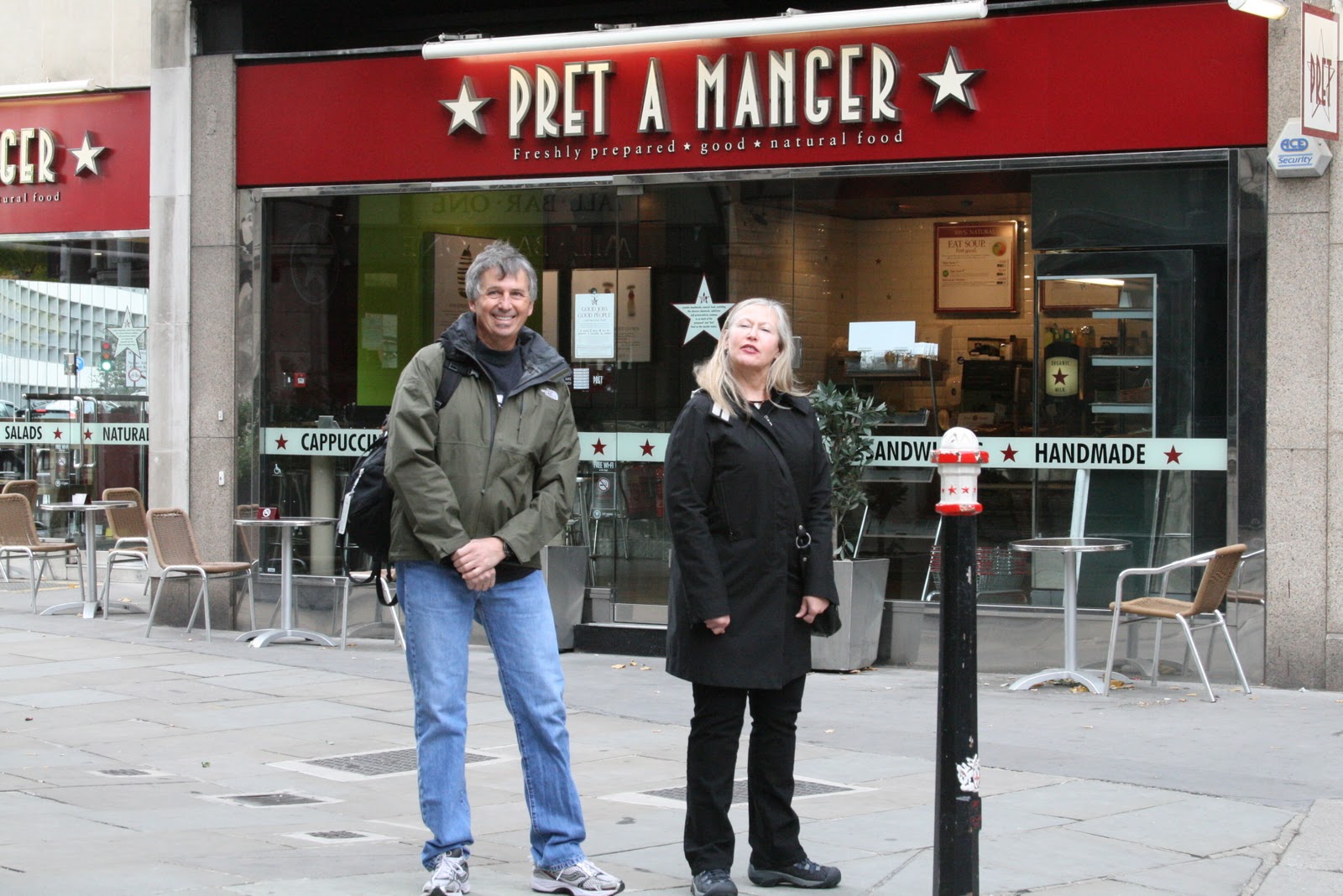
The next morning we breakfasted early at Pret-a-Mange then, after the requisite raptor’s eye view of the city from the Eye, walked to the Tate Modern. On the way we stopped at a small jewelry store in the XOXO group of shops where we’ve found jewelry for Lynn before. This time it was a necklace by an Irish artist who takes her inspiration from bog artifacts. It’s a strand of carnelian beads with occasional gold circles and a triangular pendant with an abstract design that reminds me of thorny woods.

This time the high point for me of the visit to the Tate Modern was the black and white photographs of August Sandberg and Klee’s “Walpurgis Night.” Each of Sandberg’s images is a richly allusive, frozen story in the way that Vermeer’s best paintings are. They ask you to consider both what’s gone on before and what happened after. Even the portraits and landscapes have that affect. It’s a kind of instantaneous tension. The three witches faces in Walpurgis Night are another thing all together. They ask about the absence of context. And they’re just plain spooky. After lunch in the museum restaurant looking out over the Thames, we were disappointed at St. Paul’s. Like Westminster Abbey it was closed as part of the preparations for the imminent visit of the pope to London which we planned to give a wide berth.
So we were off to the Tate Britain instead. Both Lynn and I wanted to look at the Pre-Raphaelite works there, inspired, in part by having recently watched the BBC series on the artists “Desperate Romantics.” That goal was delayed just inside the entrance by Fiona Banner’s exhibition which consisted of real jet fighter airplanes. One was suspended by its tail from the ceiling; another was on its side in the middle of the gallery. The first was a dusty gray and had feathers hand painted all over it; the second had been chromed so that you couldn’t look at it without seeing your distorted self reflected back. She was inspired by her memories of military jets flying over her during walks in the Welsh mountains with her father when she was a child.


We eventually found the Pre-Raphaelites though. And of course, I couldn’t see Millais’ Ophelia (floating in the water grasping wild flowers) without thinking about the model, Elizabeth Siddal, who’d spent hours in a Victorian bathtub and who had become seriously ill as Millais had allowed the oil lamps positioned around the base of the tub to keep the water warm to go out. But what held me was one of Burn-Jones Persephone paintings. I am deeply drawn to its wintry, gun metal spectrum as well as the characters’ expressions. Pluto, who sits almost at Persephone’s feet, looks at her with such longing and she stares out at us with such clarity, strength and loss all at once. I must also admit that I’m envious of Pluto’s armor; if only fencing gear looked that cool.

By the time we walked out, we were exhausted. “Find me a cab, I’m walked out,” Lynn said as we stepped out on a strangely empty Atterbury Street. Cars were parked all along the road but there was no traffic. Helicopters circled high over head.
Since there were no cabs we started walking east toward our hotel and then we saw the crowds and the yellow vested police. And, as Westminster Bridge came into view, our fears were confirmed: in the midst of the crowds a motorcade was crossing the bridge and in the middle of the bridge was a white vehicle with a kind of dome and a tiny red clothed figure within. In spite of our desires to the contrary, we’d found the Pope who was just arriving in London. A good English mile of walking finally led us around the commotion to a cab who in turn dropped us at a pub with a single tiny table upstairs, institutional roast beef and Yorkshire pudding but, fortunately, cold Stella Artois. “Belike then my appetite was not princely got; for, by my troth, I do now remember the poor creature, small beer.”
The next morning, which happened to be Saturday, we rendezvoused with Carolyn Foreman, a friend we’d first met dog-sledding in Svalbard. She lives and works in Oxford and drove down to join us for breakfast at Covent Garden. She was just back from a rough crossing to and from Greenland and was about to depart for South Africa. I felt fortunate that it had worked out so that the four of us could share a lazy breakfast in the sunshine which had been rare in that part of the UK as of late and would be so again very shortly. There’s nothing quite like a lazy, sunlit breakfast in a Covent Garden restaurant to make you feel that all’s right with the world even though you know it isn’t.

After a short sojourn in the British museum, we took a break and then set out to attend the primary and central reason for the trip in the first place: “Henry IV part 1” at the Globe Theatre in Southwark. To be continued of course.
Subscribe to:
Posts (Atom)