Showing posts with label fencing. Show all posts

Friday, April 10, 2015

A Fine and Terrible Mystery – Episode 10: Armiger Literatus

0 comments

My last post narrated the incident which had such profound consequences for Sir Thomas Malory’s later life and career and previous posts have discussed equally dramatic episodes earlier in his life.  The circumstances raise questions which may be impossible to answer conclusively with the extant evidence.  The words “fine” and “terrible,” which I chose to describe this topic, weren’t chosen with insouciance.  You can find the first post here.


It’s apropos now to take a short but careful look at his whole life up to this point.  Doing so reveals some important additional surprises and insights and suggests aspects of his character which may prove essential when we come to the end and address the central question of who he really was.

He was born around 1401 to a wealthy Warwickshire family, the Malorys of Newbold-Revel (the issues surrounding his date of birth are discussed in Episode 3.)  Warwickshire is sometimes called the “heart of England” if by chance you’re not familiar with it.  Not only is it beautiful and geographically central, it has always played an important role historically and culturally.  Shakespeare was born there, for example, and aspects of his life and Malory’s have some curious correspondences, but that’s a topic for a later post.  Malory had three uncles, Thomas, Simon and Robert. each of whom may have served as a different kind of chivalric paradigm, from the martial, to the urbane, to the spiritual.

Around the age of fourteen he served as one of several squires under Richard Beauchamp, the Earl of Warwick, as part of the Calais garrison which was England’s largest, best organized and most disciplined standing fighting force (David Grummitt, The Calais Garrison War and Military Service in England, 1436-1558.) He probably witnessed Warwick’s participation in the December 1414 “12th Night Tournament” outside Calais.  Indeed, Eugène Vinaver, (the first editor of Le Morte d’Arthur Winchester manuscript) believed the tournament in the tale of Sir Gareth was written in remembrance of Beauchamp’s deeds then.  (I can’t help thinking of the Winsor tournament in my own book As a Black Prince on Bloody Fields and the effect watching Henry of Grossmont had on the young Black Prince.)

I’m certain Malory’s life at that time was filled with physical training and practice.  We know how critical training was for long bowmen (the distortions in their skeletons prove it.)  I’m certain the same is true for men-at-arms.   If you’ve ever fenced, you know how critical daily training and practice are.  I can’t believe medieval sword-to-sword combat was any less intense; success was a matter of life and death.

In November of 1415, after Agincourt, one of the most important military events of the century, Henry V and his exhausted, victorious “band of brothers” arrived in Calais.  Malory probably witnessed it.  If so, it was certainly as inspirational and emotionally important to him as witnessing the moon landing was for those who witnessed that event in 1969.  When Henry died in 1422, King Arthur’s coat-of-arms were displayed along with the Plantagenet royal arms and Malory’s experience of Henry V must have informed his depiction of Arthur.

Muster rolls indicate that Malory returned to France with Henry V’s grand invasion of Normandy in 1417 as a fully armored and equipped squire under Lord Grey of Codnor and later under Warwick.  (In scale it was a kind of medieval “D-Day.”)  After the winter siege of Falaise with the King, he was part of a lightning force under Humphrey, Duke of Gloucester that captured 32 castles in six weeks.  (George Patton’s accomplishments with the US 3rd Army in WWII comes to mind as an apt analogy.)   Malory may have served at the siege of Rouen and been part of its garrison when Joan of Arc was imprisoned there.  He returned to Warwickshire in 1421.  By then his father, John Malory, had been Sheriff of Warwickshire and Leicestershire (1416-1417) and had served twice as a member of Parliament for Warwickshire.  In 1420 John was one of 13 knights and esquires deemed most able to defend the realm in the King’s absence.  The Malorys were becoming a preeminent family.

What was Thomas himself like in his twenties?  He was an experienced soldier who’d served with elite units under capable, sometimes inspiring officers and there is nothing in the record to suggest he served other than honorably.  Perhaps, he was not unlike Shakespeare’s conception of Sir Henry Hotspur:  vainglorious, heroic, quick-tempered, romantic.  Some authors have judged him as such and it’s an easy, perhaps natural rationalization for later events.

I disagree.  Two incidents in the 1420s are why.  In 1422, newly returned from France he and others pursued a suit to recover property taken possession by Richard Clodeshall but enfeoffed or owned by Malory and his co-appellants.  This shows Malory’s considered use of the legal system as a young man to address a grievance as opposed to taking the law into his own hands as he will be accused later.  Further, in September 1427, his father was chosen to sit in the Commons as MP for Warwickshire when parliamentary elections were held at Warwick, his 5th election as MP.  However, one William Petyo, a soldier who’d also served in France, marched into the sheriff’s court with a threatening retinue and insisted his name be sent in instead, which was done.  It was a direct political assault on Malory’s immediate family.  Nevertheless, it was addressed legally in 1428 when Warwick returned again from France and Peyto’s election was legally voided.

There is much less known evidence of his life in the 1430s and 1440s than one would like.  We know the extended family flourished, exhibiting fiscal conservatism and pragmatism.  We know he was married and knighted in the 1440s although there are no specific extant records of either event.  In late 1446 or early 1447 he had a son, Robert.  Nevertheless, his knighthood in his 40s is telling.  The Malorys were moderately wealthy but not so much so that knighthood was an idle honour.  Rather, it was almost certainly a life goal the achievement of which at the end of a long military career suggests dependability and responsibility as well as courage.

During that time he also served in Parliament twice, first for Warwickshire, then for Great Bedwyn in Wiltshire.  The latter appointment is interesting.  P. J. C. Field in 1993 speculated that it was as a result of the patronage of the Duke of Buckingham, Malory’s later nemesis.  Christina Hardyment, in 2004, dug deeper and showed that it was just as likely the possible patronage of the Bishop of Winchester.  This is a perfect example of how Malory scholarship remains dynamic.

Hardyment makes the further point that there may have been a literary connection betwixt Malory and the Bishop of Winchester and summarizes a list of 34 sources (some over 1,000 pages) in at least 3 languages that he used.  Le Morte d’Arthur could have been a life-long project, not just a product of his prison years.  Certainly he was one of that very rare species, like Xenophon or T. E. Lawrence:  an armiger literatus, a literary knight.

What we know of Malory’s character to this stage is far from sufficient to explain what happened next, beginning on Sunday, 25 July, 1451.  It seems particularly important to consider what other events were transpiring then, particularly in the life of Henry Stafford, the Duke of Buckingham and Richard Neville, the relatively new Earl of Warwick which is what I intend to focus on until my next post.

Episode 11 can be found here.

Friday, December 12, 2014

Go in Beauty

1 comments

What is chess, do you think?   Those who play for fun, or not at all, dismiss it as a game.  The ones who devote their lives to it, for the most part, insist it is a science. It's neither. Bobby Fischer got underneath it like no one before him and found at its center... art.  (“Searching for Bobby Fischer” by Steven Zaillian and Fred Waitzkin)

When I was thirteen, I was afraid of heights, due in part to a fall I took when I was eight which broke my right arm.  That December my mother died suddenly from a deep vein thrombosis.  The following January, my maternal uncle, William, decided to attempt to teach me to ski.  “Attempt” is the operative word: equipment then was still primitive.  My boots laced and provided minimum support, my skis were simple ash boards with metal edges.  Standing up on them, making them go in the direction I wanted them to go, even on a groomed slope, required significant effort and a technique which was contrary to a natural sense of safety.  To this day I think the reason I was first able to get on a chair lift which would swing me thirty feet into the air for the first time was that at that point in my life I didn’t care that much if I lived or died.


As I was fighting my way down my second and final run of that day, something magical happened:  I made two tentative, trembling snowplow turns in a row.  Suddenly, I was in control, suddenly I was free.  I could ski anywhere.  My adrenalin surged with the exhilaration of the realization.  I looked back up the hill at my uncle, a comfortable, inscrutable black shape watching over me from the top of the gentle slope.  I understood what skiing was, why people went through so much difficulty and discomfort to do it.

And I was wrong. 

And it wasn’t that I couldn’t go everywhere, which was true:   it was something else.

There had been a lot of snow early in the year.  In those days powder snow at the sides of the groomed slopes would remain un-skied for days or weeks and accumulate the depth of multiple storms.  A couple of weekends later when I could negotiate the slopes beneath the Albion chairlift at Alta in fifteen minutes instead of an hour or more, I stopped at the place where I’d made my first successful turns and looked back up the hill.  My uncle was no longer behind me.  Instead, he was perched at the edge of a steep ridge at the side of the slope.  Now it has a name, “Vail Ridge.”  Then it was nameless.  It was simply the craggy ridge that no one took the trouble to ski:  it was steep but too short.

Suddenly, my uncle “dropped in” to a short passage between two crags and in two fast, sweeping turns effortlessly descended through deep powder what to my mind was nearly a cliff.   The sight literally stole my breath.  My other uncle, his taciturn brother not given to hyperbole, used to say William skied the way a hawk flew and he was right.  It was the first time I glimpsed the deepest reason for skiing:  art.

These days, the aesthetics of sport receives short shrift, if it’s mentioned at all.  Yet, I find it in every sport with sufficient study.  One of the things I find particularly appealing about both skiing and fencing, is that anyone, at any level, can aspire to and accomplish an aesthetic moment, whether it’s a perfectly timed deceptive touch with an epee or a sailing turn in the fall line.  And with skiing sometimes the pursuit of art is the edge that enables you to find the courage or skill to ski something you wouldn’t otherwise.

These days, I rarely ski Vail Ridge, it’s too easy and not worth the trouble.  But when I do, I remember that day.  And then I also remember skiing West Rustler, a more formidable slope, with William when he was in his eighties, still pursuing the art.

Art is often dramatic and revelatory.  A particular run down Nina’s Curve, another slope at Alta, comes to mind.  I was skiing with a young man and his father on an icy, windy day.  Nina’s Curve has a particularly nice structure: its steepest stretch is also its narrowest.  It was the young man’s first time down and he was far from sure he could do it though both his father and I both knew he had the requisite skill.  He made one careful turn above the narrow space and came to face his father.

“Tyler you can do this,” his father said honestly, lovingly to his son.  And in that moment, I perceived a magic, essential quantum of confidence and strength pass from father to son.  His father went first and his son took a breath and followed.  I didn’t know if he would or not. It was a modest moment of drama revealing the characters of both.  Sometimes the best skiing is composed of small moments; interestingly it is how Hemingway’s story “Cross Country Snow” works.

I always watch Mark Obenhaus’s documentary “Steep,” about the history of Big Mountain and Extreme Skiing this time of year when I’m waiting for the snow to arrive.  A favorite moment is Bill Briggs description of his first, solo descent of the Grand Teton on skis, the only evidence of which was his solo tracks below the summit visible the next day.  If that wasn’t art, I don’t know what is.  Another moment is Ingrid Backstrom’s decent of a nearly vertical face of one of the mountains above Bella Coola, B.C.  The first skier down, Hugo Harrison, “who never falls,” to use Ingrid’s words, does so and then tumbles and cartwheels and tumbles for what seems like forever.  Perhaps the mountain is un-skiable. Nevertheless, the filming helicopter gives Ingrid the wiggle and she drops in.  And in a few long and amazingly fast and beautiful turns she makes a perfect descent.  I’m reminded of so many things, including my uncle’s descent of Vail Ridge long ago.  Quite simply, it’s art.  You can watch it here: Ingrid Backstrom in Steep

According to William Eastlake, the Navajo say “Go in Beauty.”

Tuesday, July 19, 2011

Fencing Summer Nationals - July 2011

0 comments

I feel the way I feel after a long hike somewhere new. The world is refreshed, bigger, more interestingly complex. “Got to love it,” to use D.Z.’s expression. We’re back from fencing in the USFA Summer Nationals.


Lynn and I drove to Reno, Nevada on Thursday, July 7th. I hadn’t driven that road in years and had forgotten how wild and even mysterious some of the basin and range geography was. Along the way Lynn texted Robert and Kim, who were driving behind us, and we listened to a fine audio book of Tinker, Tailor, Soldier, Spy. After we checked in at our hotel, the four of us went for dinner at the Pneumatic Diner, a vegan grill. A word here about the food in downtown Reno: some of it is excellent. My tacos at the Pneumatic Grill were really good, simply and perfectly because the fresh vegetables were so flavorful, and the dinner the next night, at La Vecchia, was some of the best Italian food I’ve had outside of Italy.

Of the four of us, I was the first to compete; check-in at the Reno Convention Center for mens Div III epee was the next morning at 7. I slept fitfully and dreamt my epee failed to pass a strange voltage test. Of course, there is no such thing. Kenny and Jenni, my coach and his wife arrived shortly after we did and I found them chipper and willing to hand-hold me through the formal details of national competition, even though they’d already been at it for seven days. As a result, I achieved a signal personal goal: not to embarrass myself or the club during the competition.

Though there were seven of us in the club fencing during the following three days I always had one of Kenny or Jenni strip side when I was fencing which was no small achievement. The best thing, though, was the warm-ups with Kenny. Not only did they serve to optimize my frame of mind for the competition, they were also compact, perfectly focused lessons, which have also helped me build a sharper set of priorities for the coming year. The prospect of competing in a national event focuses the mind wonderfully, to rephrase Johnson. In fact, that may be one of things I love most about fencing. The discipline tunes and strengthens perception.

I was lucky in my pool draws both for Div III and Veterans: everyone was better than I was and most, probably all, had been fencing longer than I had, in the case of Veterans, sometimes by decades. Even so, I won one pool bout, came very close in two others and there was no one I didn’t get at least a point on. Since a large part of my game involves going for hand touches, it’s a point of technique I need to give particular focus, especially aiming for where the target will be, not where it is. Similarly, my parry-ripostes need a lot of work: too often I try to counter attack in opposition and fail when a parry-riposte would be successful. In general, I found that I was seeing the weaknesses of my opponents and could discover their “emergency responses” but, having done so, was unable to take effective advantage of that knowledge. In general, my points often came early in the bouts: clearly my opponents were figuring me out as well, which is yet one more thing to work on.

Lynn had a similar experience in that regard and her results were similar to my own. One of my favorite moments of the entire competition was watching her veterans event. Suddenly, she started bouncing, which is something she normally never does. It was as if she’d suddenly discovered an infinite pool of energy. And she didn’t stop. After, I told her she reminded me of the Energizer Bunny. Her veterans bouts were as difficult and hard fought as mine as most of the women were competing for a place on the national team.


My major regret is that I was unable to see any complete bouts of some of the highly placed fencers competing, either in Nationals or in the Pan Am games in the hall next to ours. I also saw very little of Robert and Kim fencing. Afterwards, Robert told me that he’d felt that he’d never fenced better and that he’d made a kind of perceptual leap as well: there were times, he said, when he felt like a predator, keenly observing his opponent’s weaknesses. He certainly fenced exceptionally well against me in our warm-up bouts and both Kenny and Jenni commented that he had done very well against an accomplished fencer he’d drawn in his pool.

With a little encouragement from the four of us, Jenni had decided to fence and I was able to see a little of her bouts, albeit mostly from a distance. She seemed quick and formidable, significantly more so than when I’d last fenced against her in Idaho late last year. Her results were better than the those of the four of us and I found her skill and focus quietly inspirational.

So, “I’m back.” And already consider myself in training for next year.


If you’ll forgive the echo, I choose to fence not because it is easy, but because it is hard, because that goal serves to organize and measure the best of my energies and skills. It will be interesting to see how we do next year.


Sunday, June 19, 2011

On Belonging

0 comments

King Henry V: I wear it for a memorable honour; For I am Welsh, you know, good countryman.
Fluellen: All the water in Wye cannot wash your majesty's Welsh plood out of your pody, I can tell you that: God pless it and preserve it, as long as it please his grace, and his majesty too!
-Henry V, Shakespeare

In Branagh’s memorable film Henry’s line isn’t tossed away with an ironic grin as it usually was; rather it is delivered with conviction and tears of affection coming as it does at the end of the battle of Agincourt. Henry’s parentage was almost entirely Norman English but he was born in Monmouth, Wales. Did that make him Welsh or was it that he was distantly related to Llewelyn the Great through his mother making him 1/128thWelsh? My guess is that Shakespeare meant the former. Branagh’s original dramatic insight to use the line as a cue for emotional release(which is perfect for the dramatic shape of play) may also reveal Shakespeare’s vision of the character and possibly even reflect the personality of the historical Henry. Who knows? Was Henry Welsh? Does it matter?

What I find of greater interest is the audience’s response to that reading of the line. We accept it. No one takes umbrage, no one suggests it’s pretense.

Here’s a different context. I was born in the American Southwest but am of northern European decent. If I were to say to a member of the Acoma tribe of New Mexico, “I am Anasazi, you know, good countryman,” he or she would be offended, have a good laugh and perhaps even wonder if I was in need of a professional psychologist.

The thorny issue, of course, is cultural membership and ownership. When does someone have the right to claim membership in a culture. And what rights appertain to a cultural group? The problem is international and diverse. It dramatically affects how Archaeology is done in the southwestern US and politics in the Middle East to name just two examples. And it is far from sufficient to allow cultural groups to make decisions alone because of cultural conflict. Governments and global organizations are forced to arbitrate and we need them to do so.

This week I’m attending a fencing camp my club is holding. I’m looking forward to it in furtherance of my challenging goal of avoiding complete embarrassment at Nationals. The thoughts above derived from realizing that a fencing club is a kind of culture, too, with particular rules and values that differ, sometimes dramatically, from club to club. I’m particularly fond of the culture my club expresses.

And yet, isn’t every sense of belonging also haunted by a ghost of pretense? And is that such a bad thing? Pretense is sometimes the beginning of transformation, just as standing in front of a mirror with an epee repeating the same parries over and over is a kind of pretending, too.


Sunday, June 12, 2011

The Reason for Time

0 comments
“The only reason for time is so that everything doesn’t happen at once,” according to Albert Einstein. My spring has been like that, more and more everything seems to be happening at once. Also, the proportional acceleration of time due to age, (a simple lemma proceeding from the fact that one of the ways we perceive time is in proportion to the amount of time we’ve lived) contributes to that sense. Or maybe it’s just that didn’t ski enough this winter as a result of severity of the weather, especially the wind and cold.

Even so, we managed to find the single best week in May for an excursion to Chaco and Mesa Verde with Robert and Tyler. It deserves an entry of its own, obviously. What I will say now is that as a result I’m rereading Lekson’s History of the Southwest as well Marietta Wetherhill’s memoir. Both give me the sense that in spite of southwestern archaeology’s extraordinary best efforts, my view of what can be known of that time is veiled and skewed and a careful look at first sources is required to center myself again.


And, in that connection, a wicked cool video of Dr. Patricia Brown’s lecture at the Archaeology CafĂ© of the Center for Desert Archaeology is available online and well worth watching. Dr. Brown discusses the curious route that led to her discovery that a particular kind of pot found in Chaco was used for chocolate, Science and Serendipity: the Recovery of Cacao in Chaco Canyon. Warning: the tragic fate of fluffy, cute macaws also imported into the ancient southwest from Mesoamerica is also discussed in graphic detail ;-)

As of late, we’ve been fencing a lot. Besides our daily training regimen, we have three classes per week as well as two, sometimes three open fencing sessions. And, yet it’s clear from my bouts that it isn’t enough.


Friday, April 15, 2011

How does a fencer beat Goliath?

0 comments


Fencing is nearly unwatchable. The things that are important are so subtle and interpreting them is equally difficult. For example, when is one competitor’s forte (the third of the blade closest to the guard) overlapping the others foible (third of the blade toward the tip)? Does a slightly lifted arm after a parry indicate a mistake or is it a provocation? Who is provoking whom? And there’s the footwork. And all of it is happening so quickly. Even if you’re an experienced fencer it can be a challenge to know what to watch when.

But if you do have an eye for what to look for it can be compelling. The final of the senior mixed epee event of the last tournament I attended was such an event. The eventual winner had had a mixed day at best. He’d lost a pool bout he should have won and his quarter-final and semi-final direct elimination bouts were precarious. The latter was won by one point with a toe touch, if I remember correctly. And then, he had to immediately proceed into the final against a well-rested opponent. Nevertheless, he focused and rose to the occasion, which is archetypical element of almost every sports story. What was more interesting to me, however, was how he won. To my mind the single most important element was the breadth and diversity of his game. Besides being an obvious advantage to him it was also a significant disadvantage for his opponent in an interesting way. Because, there were so many possibilities, his opponent simply had to think more and more often. That made him necessarily slower, as Czajkowski points out. It increased his latency period.

A related theme is the subject of Malcolm Gladwell’s article How David Beats Goliath, currently available in the New Yorker online. Gladwell focuses predominantly on National Junior Basketball for girls and one coach’s innovative application of the full court press. The theme is that the outsider, the underdog, can win if he or she is willing and creative enough to find an unconventional strategy and sufficiently diligent to apply it successfully (as it often requires more work). He mentions several other examples, T.E. Lawrence’s innovative strategy for defeating the Turks in WWI by not attacking Medina but by disrupting the Hejaz railway instead, a naval war gamer who used an AI program to surmount nearly insurmountable odds coupled with labyrinthine rules and conventions, and George Washington’s early strategy in the US War of Independence.

Needless to say, it’s a particularly appealing stance for me as a fencer. The problem is that fencing is very old, fencers are very clever, so they’ve institutionalized the idea of stepping outside of the ordinary. Finding something truly innovative is less easy than it might be in other endeavors.

The illustration is a cartoon T.E. Lawrence drew of himself for "7 Pillars of Wisdom," one the greatest and simply enjoyable books written in the 20th century.

Thursday, April 7, 2011

Unexpected Gifts from Unexpected Lives

0 comments

When I was a child, one of my father’s favorite retorts was “you don’t know how it is. You think you’ll live forever.” The irony was that even then, when I was green and golden in the mercy of Time’s means, I was all too aware that one day Time would take me up to the swallow-thronged loft by the shadow of my hand, to borrow those famous words from Fern Hill. I’ve never felt distant from my own mortality.

We learned yesterday of the sudden death of a neighbor. Death is terrible but common place in spite of all we do to insulate ourselves. John Donne’s 17th meditation (1624) comes to mind on this occasion, as well it should. And may it always do so. But there is a reciprocal: in my selfish way I look at other lives for sources and models of strength and just as Wayne Trenbeath’s death diminishes me so am I heartened with the obstinate will and humor with which he faced his Multiple Sclerosis during the few years I knew him. Certain lives are unexpected gifts at unexpected times.

On other topics, my fencing has been a little less than optimal as of late. In the tournament before last I managed to lose all my pool bouts and in the most recent one I lost two pool bouts I could have won. Then, in the same tournament, I lost my first direct elimination bout even though I was up 12-9 at the beginning of the 2nd period. Indeed, that is becoming a dark and regular theme: I pull significantly ahead then lose. To put it more succinctly, at the moment my fencing sucks.

All of which would be fine, perhaps, if my enthusiasm for the sport wasn’t continuing to grow. The problem is that more I do it, the more knotty, difficult and interesting it is. In Tuesday’s class we worked on a new (to me) denial-of-blade counter attack that is wicked cool. So I will keep at it, remembering to apply an appropriate measure of obstinate will.

By the way, the photo is of a cottage above Newport, Pembrokeshire, Wales. I took it during the trip Lynn, Robert and I took last summer.  The name of the cottage is "Fern Hill."

Wednesday, February 16, 2011

Recalling December Fencing on a Windy Evening

0 comments

There’s a frantic wind again today. We’ve had a lot of it during the last year. Even the day last Spring when we did our little 10 mile hike in the cliffs above Pueblo Bonito in Chaco it was roaring. So I’m not skiing even though I’ve done far too little so far this year. And now Spring looms with so many different things to do.

I finally fenced in my first tournament of the new year, on February 5th, and it turned out to be particularly good fun. I won 3 of my 5 pool bouts and one was agreeably dramatic. It was against a fencer from the Pocatello club and I haven't been doing well against them lately. This time, I was soon down 3-1 but rallied and came back so that it was 4-4 when time ran out. That alone was a kind of personal victory; I’m not particularly good at coming from behind. He then won the spin of the pencil for priority so that if neither of us scored in the extra minute of overtime he’d win the bout by default. We began again. I carefully and relentlessly pushed him to the end of the strip and then simply waited. There was a moment when something in his body language told me that he was beginning to think the clock would just run out. I went, won the point and was very chuffed.

He was not.

I owed the strategy to another member of our club, a much more capable and clever fencer than I, who’d used it in the gold medal DE bout in an earlier event on the same day.

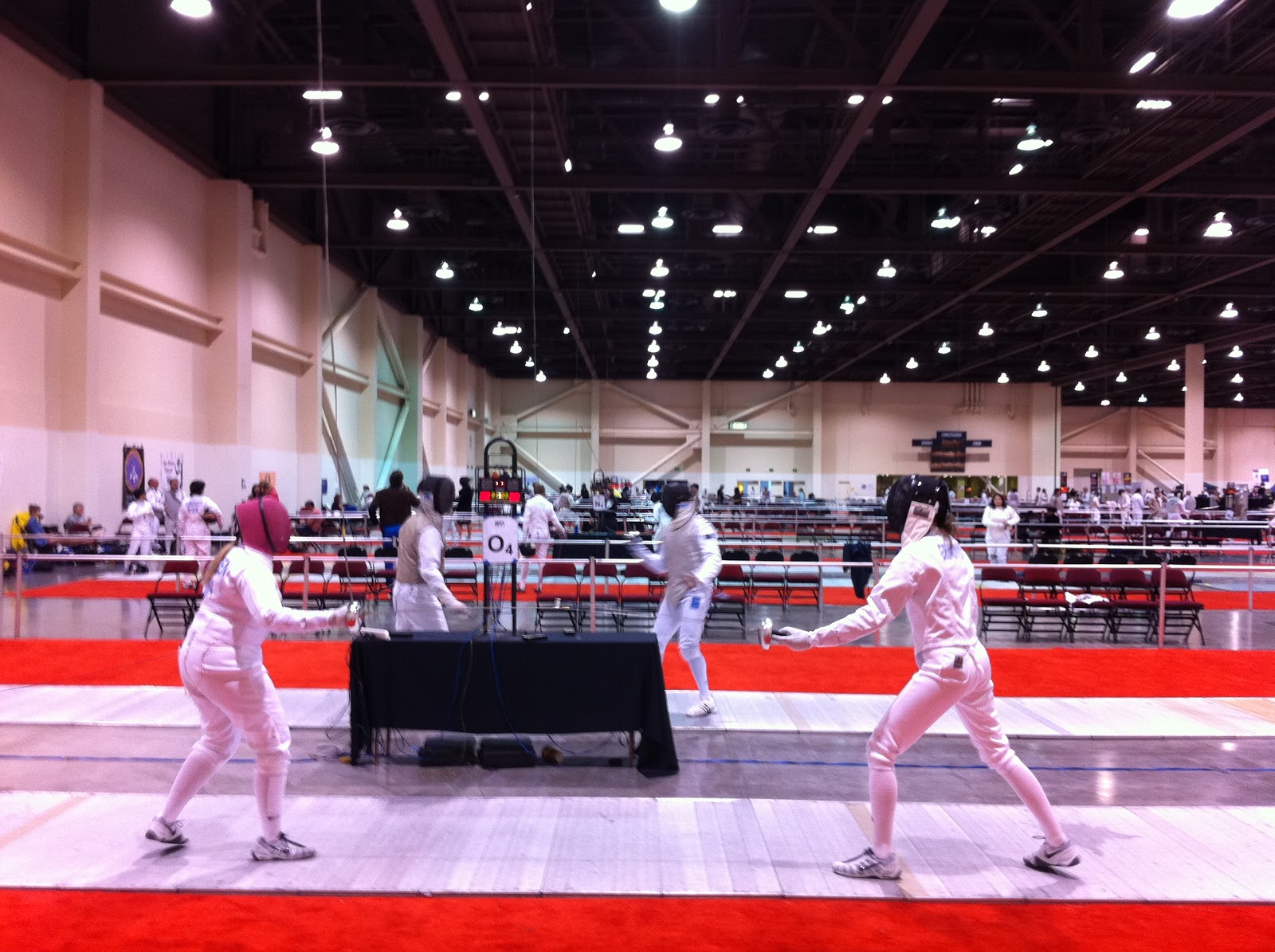
I was seeded 10th of 32 after pools and won my first direct elimination bout. My second, against a young lady in our club who has fenced internationally and is a much, much better fencer than me, went well. I lost but the score was much better than I would have hoped. And it also yielded a photo, which my cousin Robert took, of which I’m particularly fond. Here it is:


And, I owe Robert further thanks for doing the research and finding what finally appears to be some decent HD video editing software (Cyberlink’s PowerDirector 9) which works well enough with the mts HD video our Canon camera produces. This morning, I roughed something up from the footage we took at a tournament at the University of Utah on December 15th.


I should mention that though I won the bout; it was very close, much closer than the video suggests. I just happen to be more fond of the points I won, which should come as no surprise.

Thursday, January 27, 2011

Those Moments of Transcendence

0 comments

Everyone who fences sees it happen at tournaments or at practice: a less capable fencer beating a more experienced one. Certainly, it happens in other sports, too. But I suspect it’s more common in fencing than say tennis for reasons I’ll get to shortly. And it happens because of something hard to quantify or measure or even see. It’s the kind of thing that might make you believe in magic or lucky t-shirts.

In chapter 6 of Understanding Fencing, Zbigniew Czajkowski addresses it: the importance of motivation and arousal. He is careful to discriminate between the two, the former being the reasons we fence and the latter being our state of excitement during a bout. Czajkowski quotes the work of two early 20th century psychologists, Yerkes and Dodson, and the two laws they formulated about the effect levels of arousal and motivation have on performance. Their work was published in 1908 based upon empirical evidence.

The first law states that there is an optimal level of arousal and motivation for performing a task and that if you graph levels of arousal and motivation versus performance the result is an upside down U-shaped curve.

The second law states that the more complex a task is, the lower the level of arousal and motivation necessary for optimal performance. In other words, if you’re doing something that is complicated for you, if you’re too excited, you’re less likely to perform it as well as if you were more settled.

Further, and provocatively, Czajkowski suggests that one goal for training fencers is to make very complex tasks trivial to execute so that they may be performed at much higher levels of motivation and arousal. And he discusses strategies for accomplishing that, such as over-training.

By the way, Czajkowski’s book was published in 2005. In 2007, Yerkes and Dodson’s work was corroborated in part by Lupien et al, and their work on stress hormones, particularly glucocorticoids.

The reason I hypothesize that motivation and arousal play a greater role in fencing than tennis is that fencing reaction times are so very short. Both the tip of a fencing weapon and a tennis ball are generally estimated to have a top speed of approximately 120 miles per hour. However, the tennis ball often traverses a much greater distance (42 feet from service line to service line) versus a mere 2 feet in a fencing attack. The corresponding times for response are .23 seconds and .011 seconds respectively. Hence, if motivation and arousal affect reaction time it is probable they could play a much greater role in fencing where even a slight change in reaction time can change who gets the touch.

So motivation and arousal deserve particular attention from the fencer. And Socrates’ maxim, “Know Thyself,” has terrible, practical importance. Nevertheless, although Czajkowski addresses the differences between individuals in this context when he talks about the differences between “warriors” and “technical fencers,” I think the kind of motivation and arousal also deserve particular attention as well. I know I’ve been much less successful at tournaments when I was worried about doing well. Who hasn’t?

On the other side, I’ve also had the opposite experience: once almost a year ago and then again more recently. In both cases, I surpassed my self-expectation in bouts with fencers who were better and more experienced even though they were fencing well. And at both times, I recall a particular lightness of being and a sense of slowed time. My perception seemed heightened and I was able to fence with particular quickness and precision. I sensed I could do no wrong.

Do I think I was actually fencing perfectly? Of course not. But I was fencing as well as I could within the limits of my technical skill and, more importantly, my response times were substantially better than usual.

It happens in other sports as well and to competitors at the highest levels. In Levels of the Game, John Mcphee’s classic essay on a single tennis match between Arthur Ashe and Clark Graebner, the same thing happens to Ashe:
 

   Nothing has happened to Graebner’s game. It continues
   at the level of solid  excellence that has brought him, all
   even, to the present crisis.  The level of Ashe’s game,
   however, appears to have risen. He is playing with loose,
   all out, fluid abandon – prudence be damned.

Thus, among all the other things there are to learn about fencing, an important one is how to find the particular psychological regimen than optimizes your chances of finding such transcendent moments. I suspect it’s a continual battle. What works once may not work a second time, just as an attack against a good fencer may work only once. You have to find another.


Saturday, December 18, 2010

Computer Gaming and Fencing: the Transfinite Blade

0 comments

One neat sub-branch of mathematics is Cantorian set theory. Cantor took one sly strategy, now sometimes called Cantor diagonalization, and applied it over and over again (in the same way Beethoven takes a single theme and develops it into a complete symphony) to develop the basis for an algebraic structure of infinities. Infinities?

Yes, there’s more than one if by chance you didn’t know. To be precise, there are a countable but infinite number of infinities. You can ask and answer questions like if I have two sets of two different infinite sizes and I put them together what is the infinite size of the result. Actually, that isn’t as interesting a question as it first sounds. It's more interesting to ask what is the particular infinite cardinality of interesting sets, say the Imaginary Numbers. And infinities can be ordered: one is strictly larger than another.

At this point I should mention that I have the highest regard for games, particularly those requiring strategy and analysis. Ever since 8 hours of Bridge with some particularly enjoyable partners turned a miserable, interminable wait in the Iquitos, Peru airport for a vintage airplane to take Lynn and I over the Andes into a pleasant day, I’ve had faith in the transcendent and transformative powers of games. And, obviously, games themselves can be art, just as playing them can be as shown by Ricky Jay, Bobby Fischer et al.

So I’ve just downloaded a wicked cool new game, an app for the IPAD, “Infinity Blade,” which, for once, lives up to the high praise it’s received. In spite of the limitations of the IPAD graphics engine, the game delivers dynamic real time graphics in a class with the best MMOs. But what I find particularly interesting is the game play itself, particularly the user interaction. For once, medieval combat is not trivially reduced to pushing a handful of virtual buttons. Instead, the touch screen swipe action is mapped to sword movement. Now, at any given instant you have to make the choice of whether to block or to attack and you have an infinite number of choices of how to sweep the blade, which yield greatly varying results. Combat requires continual focus, some precise hand muscle motor skills, even a little strategy. (Sound familiar?) In the parlance of the computer gaming development community, that makes the game deeply “emergent,” a very good thing.

Which leads me, naturally, to fencing. Among many other things it’s a game, too, in the strictest sense. However, I will spare you the formal, but trivial, argument showing that the infinity of potential actions in fencing is strictly larger than those in Infinity Blade. Further, stepping up into the meta-game, there are an infinite number of strategies within which are an infinite number of tactics which can lead to those actions. And it requires precise control and coordination of large and small muscles across the entire body.

So, from a certain point of view, fencing can be viewed as the equivalent of extreme computer gaming, even though a computer isn’t required.

Wednesday, December 15, 2010

U of U Epee Circuit Tournament. On the Dangers of Exhilaration

0 comments

One of the many memorable incidents in Lean’s “Lawrence of Arabia” is the is the camel charge of the Arab army into Aqaba during WWI. Freddie Young’s cinematography is spectacular; the young Peter O’Toole is dashing and passionate. Nevertheless, glorious as it is, T.E.’s description of the actual event in 7 Pillars of Wisdom is much better dramatically and has the signal virtue of being true. As Lawrence was riding pell-mell down a dune waving and firing his service revolver, his camel was abruptly shot out from beneath him and he was sent tumbling over the poor creature’s head. It was only after he’d stumbled to his senses and the tumult had passed that he realized that in the confusion he, himself, had shot his own mount by mistake. Lawrence’s self-effacing style is sometimes dismissed as disingenuous. I perceive his voice as a lens offering safety and strength through which he was able and willing to see the truth about the violence, chaos and weird, horrific humor of battle. In its own way it’s as immediate and visceral as the Wilfred Owen’s poetry or Hemingway’s early stories.

The incident came to mind Saturday at the USI Epee Circuit Tournament #4 at the University of Utah. Unlike the Weber State venue last month, the gymnasium was spare: just a large room with dirty white walls and, fortunately, a decent wood floor. The venue had been changed at the last minute requiring re-taping and setting all of the strips. Nevertheless, we started on time and the pools and DEs I saw were conducted efficiently and expeditiously. That may sound like a small thing but if you’ve ever participated in a competition where pool bouts were delayed because, for example, over-lapping events ran long, you know how dreary it is and how it can take a terrible toll on performance. If you don’t know when you’re going to fence it’s impossible to be ready.

We arrived a half hour early for the event, as had most of the other fencers. The room was cold. The pale faces and distract conversations suggested a higher level of stress than at the previous circuit tournaments, possibly because it was the last of the year. I stretched, warmed up and bouted with my cousin Robert in preparation, but it wasn’t clearly enough as I realized later. A critical mistake.

My first pool bout was against a newer member of our club. He’s capable, intelligent, athletic and he’s beat me in practice. It was a difficult and exhausting bout but I won with hand touches, one attack into his preparation and counter attacks that closed the line after his attack was short. The key was managing distance and that’s probably the most important thing I’ve been able to put into practice this year. Afterwards, I was confident, a bit exhilarated and totally exhausted. My warm up had been far from sufficient. Lynn suggested I eat a banana and I stupidly refused.

And so after that I promptly lost my remaining 4 pool bouts. Some were against better fencers, but some were not. And though I had a few good touches (a nice bind on a fencer with a rigid arm), my focus and attentiveness were far from where they should have been. Our pools finished early; many of the other strips were still busy. As I looked around, slightly dazed and embarrassed, Lawrence’s experience of shooting his own camel came to mind.

By the time DE’s started I was settled, nourished, warmed up and ready to battle back. I won my first DE, ironically against the clubmate I’d faced in my pool but then lost the second. He was a better fencer by multiple measures but I felt I should have taken more points in the encounter. The one positive point and most important aspect was that my coach came by during the bout and gave me some direction, which I then successfully applied to win a point. It may sound trivial, even to some fencers, but because of the speed and complexity of the sport it can be extremely difficult to do. But it can also be critical: at the last tournament the top fencer in our club won the final match in the tournament in part because he was able to do just that. To my mind, it’s a skill as important as knowing how to advance, lunge or parry.

My favorite bout of the day, however, turned out to be one that I had the pleasure to direct. It was a semifinal in the mixed senior event between two clubmates, Tom Gandy and Dakota Nollner. Both have improved during the last year and I suspect that improvement has not come easily for either, albeit for different reasons. From the very beginning it was clear it would be fierce. Almost every point was careful, demanding and draining. My favorite was the last: they were tied at 14 all. After a little blade play, Dakota suddenly and unexpectedly went for a low percentage shot, a toe touch. And got it. It was both elegant and clever. When he took off his mask and yelled I thought it was one of the few overt displays of passion that day that was merited.

The thing that stood out about the veterans event that followed was that everyone had improved. By now, I was fencing consistently, and doing consistently better. I was where I should have been in the morning when we’d first started.

Two regrets: the first, which I’ve already mentioned, is that in spite of my age and experience I persist in learning things the hard way. The second is that because I spent so much time watching the people I was competing against, I saw little of the other bouts, particularly, Lynn’s and Robert’s.