Thursday, October 14, 2010

Witches, Saag Gosht, Hal and Falstaff, Air Fencing, Castles, Welsh Cliff Walks part 3

0 comments

I’ve always been fond of Stratford-upon-Avon ever since my first visit (to see the RSC/Terry Hand’s production of Henry V with Allan Howard). Given the continual impact of tourism for decades I’ve always thought the District Council did a commendable job of maintaining the town’s character while allowing it to evolve. And this time, our accommodations (the Cherry Trees), was exceptional on all points and served one of the best English breakfasts I’ve had ever (replete with homemade marmalade). Lynn was particularly fond of their side jetting showers and the garden off our room.

For all that, I found the half day we were there to be saddening and I was glad to be away the next morning. Robert and I visited Shakespeare’s Birthplace which has evolved into a kind of Disney ride nightmare. To begin we were shuffled from locked room to locked room and shown banal, generic video presumably to increase our interest and understanding of the import of what we were about to see. By the time we escaped to the garden we were so bored and furious that we left without seeing the house itself. Who do they imagine it appeals to? Martians? I also discern a similar spirit of frantic, popular appeal in some of the recent events the RSC has advertized while the old theatre has been gutted and remodeled. Fortunately, that is nearly done. I can only hope that the RSC, the National Trust (or whoever is responsible for the Birthplace nightmare ride), and the District Council can find a better vision of what Stratford is and can be.

To my mind, it’s all about the plays: introducing people to them, creating seminal productions that stay with people for a life time, showing people how a glover’s son from Stratford came to write them.


The next morning after rambling all over Ludlow Castle, we continue northwest to Shrewsbury and then, Wales. To be continued.

Sunday, October 10, 2010

Witches, Saag Gosht, Hal and Falstaff, Air Fencing, Castles, Welsh Cliff Walks part 2

0 comments

I first saw “Henry IV part 1” at the Utah Shakespeare Festival in Cedar City Utah shortly after graduating from high school. At the time I’d read some Shakespeare, seen some plays, like any sentient eighteen year old could identify deeply, passionately and morosely with Hamlet (no doubt to the great boredom of the friends and family around me.)

But “Henry IV part 1” was a vision. It challenged me at so many levels at once. It portrayed the end of an age, the late medieval, giving birth to a new one, the Renaissance. It portrayed a political climate fraught with conflict, rebellion and ambiguous choice. Both were more than relevant to life in western America in the 1970’s. Finally, and most pertinently for me then, it portrayed a young person inventing himself from the flawed examples of many people from many different ages and social classes and achieving a kind of redemption as a result. Not only did it provide a model of how the world worked, it gave me practical clues about how to be a better and stronger person in it.

Since then Shakespeare’s English histories have risen in everyone’s consciousness and most critics estimation. They are “the national epic.”

I’ve lost track of the number of productions I’ve seen. Some were exceptional: Adrian Noble’s RSC production in 1991 with the late Robert Stephens, Michael Maloney, and Julian Glover and more recently, the Nicholas Hytner’s production at the National with Matthew Mcfadyen and Michael Gambon in 2005 to name two. To my mind, Dominic Dromgoole’s production this year at the Globe with Roger Allam as Falstaff and Jamie Parker as Hal belong in that extraordinary company.


Allam’s Falstaff is new, (no small accomplishment when you consider the legacy of the role). He is comic without being a buffoon. His imitations of Hal and youth are funny but not comically pathetic; they’re self-knowingly silly and clever. And yet, given how funny he was, he still was almost evil enough, but not quite. (On that point, Anthony Quayle’s performance is the archetype.) Hence, Jamie Parker had no small task: Hal has fewer lines, is less funny, and all to easily can fade into the background. But finally, it is his play. And Parker managed it, his comic timing was perfect and he used ambiguity at multiple levels to hold focus. He makes us wonder if Hal is “good” and what that means. He makes us wonder if Hal is on a hero's path or a tragic one and are the two necessarily the same. Mr. Dromgoole and the cast more than deserve the kudos they’ve received.

At Robert’s suggestion we went for an early visit to the Tower Sunday morning. I’ve seen the place many times but am finally beginning to see it in a new way. It’s as if I’m beginning to see beyond the veil of all the dramatic historical events that took place there to see it in a broader, historical and archaeological context. The restoration of Edward I’s medieval palace within the Tower helps immensely in that regard. The Historical Royal Palaces Charity that manages the Tower has done something very valuable and interesting. They’ve taken what used to be a warehouse for crown jewels, armor, and implements of torture and quietly made many more historical aspects available to visitors.

That evening, we dined at Tas, a Turkish restaurant a few steps from the Globe Theatre, that Robert had pulled us into the last time all of us were in London together. It was packed; nevertheless, we were seated quickly, service was prompt and the food was better than the first time we were there. I particularly enjoyed my Kusbasili pide (lamb, green peppers, pine nuts, parsley, oregano.)

All day long I looked forward to the evening and “Henry IV part 2.” For many reasons it is a difficult play and calls for different imaginative leaps than part 1. While it was definitely successful and accomplished, I left feeling that the cast hadn’t had the time to invest the imaginative energy into it, because of the claims of part 1. Still I have all toes and fingers crossed hoping that video productions that the Globe have made are released to DVD as they’ve said they will be.

Early Monday, we checked out, rented a car in Russell Square and headed for northern Wales with an evening’s stop in Stratford-upon-Avon.

Thursday, October 7, 2010

Witches, Saag Gosht, Hal and Falstaff, Air Fencing, Castles, Welsh Cliff Walks part 1

0 comments

Klee’s Walpurgis witches, Tamarind’s Saag Gosht, Hal and Falstaff, air fencing on Iron Age monuments, cliff walking in Wales, where to start? At the beginning. Lynn, Robert and I are just back from a couple of weeks in the UK.

Lynn and I flew Virgin Atlantic Upper Class over the water and it was a treat as it always has been in the past. Nothing beats sleeping flat and the difference it makes in the first day. After we arrived and rendezvoused with Robert, the three of us walked a bit, spent more time than Lynn would have liked looking at hand painted soldiers and knights at a shop in the Piccadilly Arcade, then hoofed the short distance to Queen Street and Tamarind, my favorite restaurant in London. They serve, in their words, “traditional Moghul cuisine,” prepared meticulously with fresh ingredients. I’ve never had any other Indian food that even came close, even in the UK. That night we tried Dal Makhni, (slow cooked black lentils), which were a revelation. I don’t even like lentils. Correction: there was a time when I didn’t like lentils.

As we walked back to our hotel, the Swiss Howard on the Thames across from the National Theatre, we walked through Trafalgar where there was a curious exhibition of automotive factory robots re-tasked to write text on a circular screen that on-lookers had sent from their cell phones. Someone wished someone happy birthday; the arms of the robots swung and reached in unison as they wrote. There’s always something going on in Trafalgar it seems. I was more drawn to a large ship in a bottle on a pedestal that looked like some kind of Asian homage to Nelson and HMS Victory but could have been something entirely different.

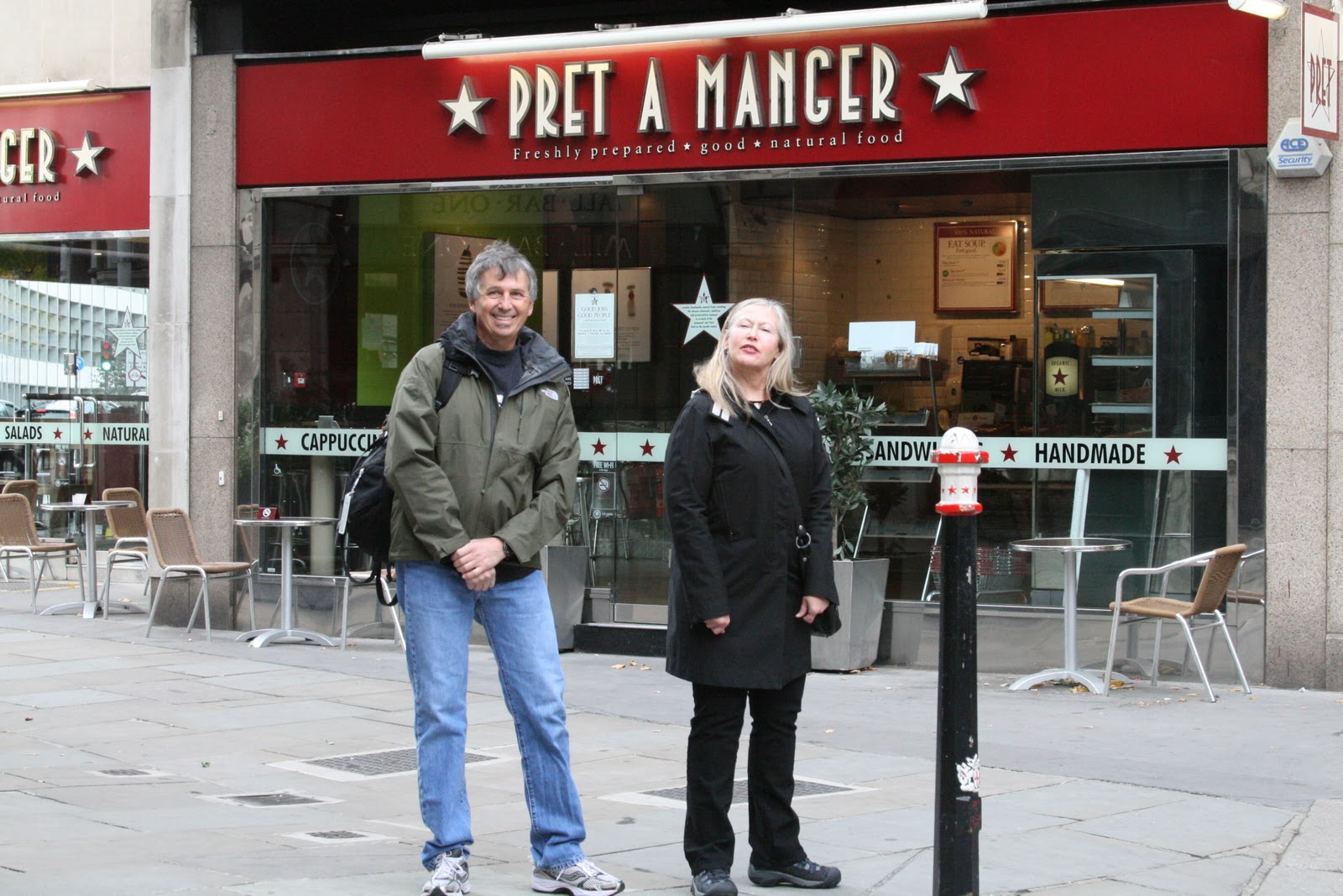
The next morning we breakfasted early at Pret-a-Mange then, after the requisite raptor’s eye view of the city from the Eye, walked to the Tate Modern. On the way we stopped at a small jewelry store in the XOXO group of shops where we’ve found jewelry for Lynn before. This time it was a necklace by an Irish artist who takes her inspiration from bog artifacts. It’s a strand of carnelian beads with occasional gold circles and a triangular pendant with an abstract design that reminds me of thorny woods.

This time the high point for me of the visit to the Tate Modern was the black and white photographs of August Sandberg and Klee’s “Walpurgis Night.” Each of Sandberg’s images is a richly allusive, frozen story in the way that Vermeer’s best paintings are. They ask you to consider both what’s gone on before and what happened after. Even the portraits and landscapes have that affect. It’s a kind of instantaneous tension. The three witches faces in Walpurgis Night are another thing all together. They ask about the absence of context. And they’re just plain spooky. After lunch in the museum restaurant looking out over the Thames, we were disappointed at St. Paul’s. Like Westminster Abbey it was closed as part of the preparations for the imminent visit of the pope to London which we planned to give a wide berth.

So we were off to the Tate Britain instead. Both Lynn and I wanted to look at the Pre-Raphaelite works there, inspired, in part by having recently watched the BBC series on the artists “Desperate Romantics.” That goal was delayed just inside the entrance by Fiona Banner’s exhibition which consisted of real jet fighter airplanes. One was suspended by its tail from the ceiling; another was on its side in the middle of the gallery. The first was a dusty gray and had feathers hand painted all over it; the second had been chromed so that you couldn’t look at it without seeing your distorted self reflected back. She was inspired by her memories of military jets flying over her during walks in the Welsh mountains with her father when she was a child.

We eventually found the Pre-Raphaelites though. And of course, I couldn’t see Millais’ Ophelia (floating in the water grasping wild flowers) without thinking about the model, Elizabeth Siddal, who’d spent hours in a Victorian bathtub and who had become seriously ill as Millais had allowed the oil lamps positioned around the base of the tub to keep the water warm to go out. But what held me was one of Burn-Jones Persephone paintings. I am deeply drawn to its wintry, gun metal spectrum as well as the characters’ expressions. Pluto, who sits almost at Persephone’s feet, looks at her with such longing and she stares out at us with such clarity, strength and loss all at once. I must also admit that I’m envious of Pluto’s armor; if only fencing gear looked that cool.

By the time we walked out, we were exhausted. “Find me a cab, I’m walked out,” Lynn said as we stepped out on a strangely empty Atterbury Street. Cars were parked all along the road but there was no traffic. Helicopters circled high over head.

Since there were no cabs we started walking east toward our hotel and then we saw the crowds and the yellow vested police. And, as Westminster Bridge came into view, our fears were confirmed: in the midst of the crowds a motorcade was crossing the bridge and in the middle of the bridge was a white vehicle with a kind of dome and a tiny red clothed figure within. In spite of our desires to the contrary, we’d found the Pope who was just arriving in London. A good English mile of walking finally led us around the commotion to a cab who in turn dropped us at a pub with a single tiny table upstairs, institutional roast beef and Yorkshire pudding but, fortunately, cold Stella Artois. “Belike then my appetite was not princely got; for, by my troth, I do now remember the poor creature, small beer.”

The next morning, which happened to be Saturday, we rendezvoused with Carolyn Foreman, a friend we’d first met dog-sledding in Svalbard. She lives and works in Oxford and drove down to join us for breakfast at Covent Garden. She was just back from a rough crossing to and from Greenland and was about to depart for South Africa. I felt fortunate that it had worked out so that the four of us could share a lazy breakfast in the sunshine which had been rare in that part of the UK as of late and would be so again very shortly. There’s nothing quite like a lazy, sunlit breakfast in a Covent Garden restaurant to make you feel that all’s right with the world even though you know it isn’t.

After a short sojourn in the British museum, we took a break and then set out to attend the primary and central reason for the trip in the first place: “Henry IV part 1” at the Globe Theatre in Southwark. To be continued of course.

Friday, September 3, 2010

Fencing on the Roof Redux

0 comments

It’s Friday so we must have fenced on the roof again this morning. And we did. Kim joined us so that we were four. We began at 7:30 which meant that the sun was only a glow behind the mountains and there was a steady canyon wind.

I’m continuing to work on my 3 parry (close in, last minute parry to the outside). I died every time I tried it, especially against Kim who was unstoppable today. Worse, I saw her doing very successful 2 and 3 parries and ripostes almost nonchalantly. However, I now have a sense of what I was doing wrong: I wasn’t stepping in close enough, and I was chicken-winging so that my arm was exposed which was where she and Robert were getting most of their hits. As Kenny, our coach, pointed out at class on Tuesday, I need to practice in front of the mirror to correct my form.

Lynn had some nice bouts even though she’s fighting off a cold at the moment. She did particularly well against Robert in the first bout (7-4). Robert’s form also looked much better today than it did at open fencing on Monday.

Eventually, the sun rose, the wind fell and you could see that some of the trees on the hillside had that paleness that presages a change of color. Fall is coming.

Over on the gray epee , Jim Kent has a very enjoyable post on his most recent tournament experience and his predilection for playing Sherlock Holmes as he watches other fencers. He mentions that a majority of his touches were from straight attacks. I had an experience something like that during open fencing a week ago. Nevertheless, it’s surprising how complicated you can make a straight attack using timing, distance and speed.

After fencing we had Lynn’s exceptional breakfast of perfectly fried eggs, toast from my homemade rye bread, chunked cantaloupe and blue berries and a glass of carrot juice mixed with orange juice. Not such a bad start to a Labor Day Weekend.

Monday, August 30, 2010

Fencing in the Room Full of Mirrors

0 comments


We fenced at the University of Utah yesterday afternoon in my favorite room. It’s primary use is for ballroom dancing practice. It’s warmly lit, has a nicely cushioned hard wood floor and it’s full of mirrors. During summer break the very long halls leading to it weren’t lit which made it pleasantly spooky as well. Perfect.

There were only four of us and one strip yesterday which meant we all fenced a lot. My favorite bout was between Lynn and Kim that Kim won by one point. In spite of the gentle light and their collegial relationship it was evident that both really wanted to win.

At the end we did a quick team match (two against two) to twenty which was particularly fun. What is it about team matches that increases the stress and adrenalin, all in a good way? Kim and Robert beat Lynn and I but it was close.

During the bouts I worked to use close and ceding parries (3, 5 and 2) and was killed almost every time. Not only does it take a bit of courage to step in at the critical moment, the timing is delicate. I’ve only had it work once. That was last Friday morning when we were fencing on the roof.

I’ve added Claire Bennett and Tim Morehouse to the set of fencing blogs I regularly look at. But my favorite post this week was from Peach on fencing.net entitled Grrrr. She writes about fencing a curmudgeonly 90 year old. You can’t help but chortle but I think they’re both heroes, too. Not such a bad combination.

Wednesday, August 25, 2010

Dear A. S. Byatt

0 comments

On the Guardian website this afternoon there’s an interview with A. S. Byatt, a favorite novelist of mine. I first came to her with Possession, a deliciously dense literary romance. It’s a highly allusive book, both literally and virtually as she creates her own fictive 19th century poets whom the twenthieth century characters pursue. In the context of that quest, it is a romance in the medieval sense as well, a kind of virtual romance if you will. Nevertheless, my favorite novel of hers is The Virgin in the Garden which takes place during an Elizabethan festival in Yorkshire celebrated during the coronation of Elizabeth II. The festival is also a virtual counterpart and foil to the bare, parsimonious life of post war England.

Now, what I find curious and humorous is that in the Guardian Interview, Byatt discusses “the blogosphere,” Facebook and twittering and states that they have replaced god for many people. She says that the name “Facebook” is telling because people need it to show themselves who they are. She finishes by stating that she would like to see someone who can explore such lives in fiction but she is too old.

I disagree completely. She’s “up in the night,” as a favorite grandmother of mine used to say meaning that someone was utterly wrong-headed. Facebook, etc. have nothing to do with anyone’s belief in the existence of god. What they are part of is the increasing spectrum of virtuality that now inflects all experience. It’s a broad spectrum indeed, subsuming something as simple as cell phone communication and extending to the richness and complexity of virtual worlds found in computer gaming.

Given the parallel worlds present in most of her work, the virtual connections she makes in the two seminal novels of hers mentioned above I’m surprised she doesn’t feel equipped to explore it. Or maybe it’s just that she thinks her virtualities lie outside of that spectrum. I don’t think they do.

Feint-of-Parry

0 comments


Monday night and in yesterday's class we worked on feint-of-parry to each quadrant and possible responses. There are always three other main parries available (the other three open quadrants) and at least one ceding parry. Kenny, our coach, presented this so clearly and succinctly that I actually can imagine taking advantage of the diversity during real bouts although my attempts during open fencing Monday evening were less than successful. I like it a lot. It's yet another way to introduce and manage complexity in the game.

Also, as I was suiting up, I watched the other fencers in the club. We'd only missed a week because of the Pecos Conference, but I could see distinct and significant improvements and changes in several of the fencers. It could be a very interesting and surprising year for several of them.

And last night, Lynn and I finished watching Desperate Romantics the BBC series drama about the Pre-Raphaelites. I was very fond of it, on a number of levels. Indeed, it's possibly the best BBC series I've seen in years. Rossetti dominates and poor old Burne-Jones (of whose work I'm most fond) receives short shrift. But that's to be expected I guess. A little web research revealed that Ken Russell ("Women in Love," etc.) made a bio-pic about Rossetti and Elizabeth Siddal back in the 1960s; I definitely need to check that out.

I also discovered Zoe Keating's music this week which I find I can listen to over and over.

The Burne-Jones painting of Perseus seems like a nice representation of fighting and managing complexity.